

5.56 vs .308: The Complete Cartridge Comparison for Hunters and Shooters
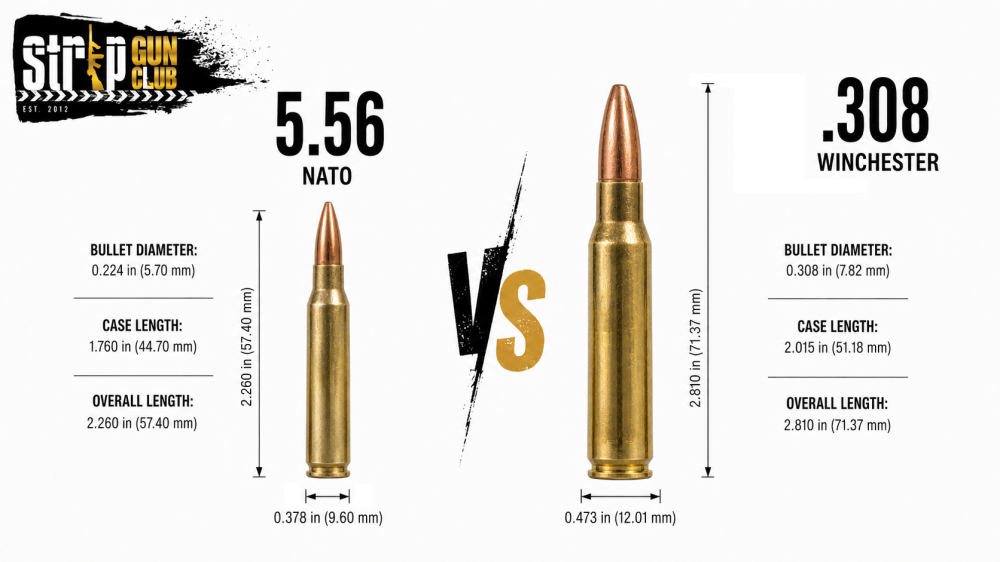
If you’ve spent any time behind a rifle, you’ve heard the debate: 5.56 vs .308. It’s one of the oldest arguments in the shooting world, and for good reason — the .308 Winchester and the 5.56 NATO are the two most popular centerfire rifle cartridges in America. Both were born from military necessity, both dominate the civilian market, and both have die-hard fans who will tell you the other one is a mistake.
Here’s the truth: neither cartridge is “better.” They were designed to solve different problems, and the right one for you depends entirely on what you want to do behind the trigger. In this guide, we’ll break down the history, the ballistics, the recoil, the cost, and everything in between — so the next time you step up to the firing line, you know exactly what you’re shooting and why.
A Quick History: From the M1 Garand to the AR Platform
To understand the 556 vs 308 rivalry, you have to go back to the end of World War II. The U.S. military had won the war with the .30-06 Springfield in the M1 Garand, a full-power cartridge that hit hard but kicked hard, too. As the Korean War gave way to the Cold War, military planners wanted something more controllable in the new era of select-fire rifles — a lesson driven home by the German Stg-44 and the Soviet AK-47. You can try out the M1 Garand rifle as part of our WW2 Package.
The first answer was the 7.62x51mm NATO, adopted in 1954 and fielded in the M14 rifle. It delivered nearly .30-06 performance in a shorter case that fit a short-action rifle. Winchester saw the commercial potential immediately and released the civilian version — the .308 Winchester — in 1952, two years before NATO even finalized the military spec.
But the M14 proved hard to control in full-auto, and soldiers could only carry so much heavy 7.62 ammo. Enter Eugene Stoner, the legendary engineer at Armalite (then a division of Fairchild Industries). Stoner first designed the AR-10 around the 7.62 NATO cartridge, then scaled the design down for a new small-caliber, high-velocity round developed with Remington Arms: the .223 Remington. That scaled-down rifle became the AR-15, which the military adopted as the M16 during the Vietnam War. The military cartridge was standardized as the 5.56x45mm NATO (with an assist from FN Herstal, which developed the later SS109/M855 loading).
Sixty years later, both cartridges are still standard NATO issue — the 5.56 in the M4 Carbine, the 7.62 in precision rifles like the M110 SASS and machine guns like the M240B — and both fill the racks at every gun store and shooting range in the country.
Is .223 the Same as 5.56? Is .308 the Same as 7.62?
Almost, but not quite. This trips up a lot of new shooters, so let’s clear it up:
.223 Remington vs 5.56 NATO: The cartridges share identical external dimensions, but 5.56 NATO is loaded to a higher chamber pressure (roughly 58,000–62,000 psi versus about 55,000 psi for .223 Rem per SAAMI spec), and 5.56 chambers have a longer throat (leade). The practical rule: you can safely shoot .223 Remington in a 5.56 NATO chamber, but you should not shoot 5.56 in a rifle chambered strictly for .223 Remington. If you want the best of both worlds, look for a 223 Wylde chamber — a hybrid design that safely handles 5.56 pressures while delivering match-grade .223 accuracy.
.308 Winchester vs 7.62x51mm NATO: Here, the relationship is reversed in spirit. The .308 Win is actually loaded to slightly higher pressure than 7.62 NATO. Shooting 7.62 NATO in a .308 rifle is a non-issue; shooting hot commercial .308 in some older military 7.62 rifles warrants a little more caution. For modern factory rifles, you’ll almost never have a problem in either direction.
.308 vs 5.56 Comparison Table
| Category | 5.56 NATO / .223 Rem | .308 Win / 7.62 NATO |
|---|---|---|
| Bullet diameter | .224″ | .308″ |
| Typical bullet weights | 55–77 grains | 120–180 grains |
| Muzzle velocity (typical) | ~2,700–3,200 fps | ~2,600–2,800 fps |
| Muzzle energy (typical) | ~1,200–1,300 ft-lbs | ~2,500–2,700 ft-lbs |
| Felt recoil (semi-auto) | ~3–5 ft-lbs | ~15–20 ft-lbs |
| Cartridge overall length | 2.26″ (mini/intermediate) | 2.8″ (short action) |
| Effective range (practical) | ~500–600 yards | ~800–1,000 yards |
| Loaded weight per round | ~12 grams | ~24 grams |
| Primary platform | AR-15 | AR-10, bolt-action |
| Cost per round (FMJ range ammo) | Lower — cheapest centerfire rifle ammo | Roughly 2x the price of 5.56 |
| Best for | High-volume range shooting, training, varmints | Long-range precision, big game, energy on target |
Recoil: The 5.56 Wins, and It’s Not Close
Recoil is where the 5.56 makes its strongest argument. A 5.56 in a standard AR-15 generates around 3–5 ft-lbs of recoil energy — barely a nudge. A .308 in a comparable semi-auto produces three to four times that.
Why does this matter at the range? Because low recoil means faster follow-up shots, less fatigue over a long session, and far less flinch development for new shooters. If you’re introducing a first-timer to centerfire rifles, the 5.56 is the obvious teaching tool. That said, .308 recoil is very manageable in a gas-operated AR-10 — stout, not punishing — and plenty of shooters find it downright fun.
Weight and Ammo Capacity
A loaded 5.56 round weighs about half of a loaded .308. That’s why the military made the switch in the 1960s: a soldier could carry roughly twice the ammunition for the same weight. For range shooters, the math shows up in your range bag instead of your rucksack — 200 rounds of 5.56 is an easy carry, while 200 rounds of .308 will remind you it’s there. Magazines follow the same pattern: a 20-round AR-10 mag weighs about as much as a 30-round AR-15 mag.
Trajectory and Effective Range
Out of the muzzle, the 5.56 is the flatter shooter. Its lightweight 55–77 grain bullets leave the barrel at up to 3,200 fps, giving it a laser-flat trajectory inside 300 yards with minimal bullet drop. For most indoor and mid-range outdoor shooting, the 5.56 makes hitting easy.
Stretch the distance, though, and the picture flips. The .308’s heavier bullets carry a higher ballistic coefficient, meaning they retain velocity and resist wind drift far better at distance. Past 500–600 yards, the 5.56’s light bullets shed energy quickly and get pushed around by the wind, while the .308 remains stable, predictable, and lethal on steel well past 800 yards. This is why the .308 remained the standard for military and law enforcement sniping for decades, and why it’s still a staple in long-range shooting and precision competition.
Accuracy and Precision
Both cartridges are inherently accurate — sub-MOA rifles exist in both chamberings, from precision AR builds to bolt guns like the Remington 700, Savage 110, Ruger M77 Hawkeye, Browning X-Bolt, and Weatherby Vanguard. Inside 300 yards, a good .223 with match ammo (especially through a 223 Wylde barrel) will shoot right alongside a .308. Beyond that, the .308’s superior ballistics give it the practical accuracy edge, simply because it’s less affected by wind and drop estimation errors.
Energy on Target and Terminal Performance
There’s no debating this category: the .308 delivers roughly twice the muzzle energy of the 5.56 — about 2,600 ft-lbs versus 1,300 ft-lbs — and holds its advantage all the way downrange. That’s why hunters reach for the .308 for deer and elk-sized game, where premium loads and bullets have earned a near-legendary reputation, while the 5.56/.223 is traditionally a varmint and predator cartridge (coyotes, prairie dogs) with big-game use limited to states that allow it and shooters who choose heavy bonded or all-copper bullets carefully.
For the range shooter, energy shows up as authority on steel: a .308 rings a distant gong with a satisfying whack that a 5.56 simply can’t match. There’s a reason people grin the first time they send a 168-grain match bullet at a 600-yard plate.
Platform: AR-15 vs AR-10
Cartridge choice usually means platform choice. The AR-15 (5.56) is lighter — typically 6–7 pounds — with lighter magazines, lower parts cost, and the largest aftermarket in firearms history. The AR-10 (.308) runs 8–9+ pounds, costs more to build and feed, and has less parts standardization between manufacturers. Bolt-action shooters have it easier: the .308’s 2.8″ overall length fits standard short actions, while the .223’s 2.26″ length has even spawned dedicated mini actions from makers like Howa, with precision builders like Wilson Combat offering superb rifles in both chamberings.
Ammunition Cost and Availability
Both cartridges enjoy the best availability of any centerfire rifle rounds on the planet — every manufacturer loads them, and bulk ammo deals abound for both 5.56 bulk ammo and 308 bulk ammo. The difference is price: basic FMJ range ammo brands run roughly half the cost per round in 5.56 compared to .308. If your goal is maximum trigger time per dollar, the 5.56 is the volume shooter’s cartridge, full stop.
Reloaders, take note: the .308 is arguably the more rewarding cartridge at the bench. Its case is famously consistent and forgiving, brass is everywhere, and component bullets from makers like Barnes and Berry’s Bullets span a huge 110–180 grain range. The .223 is also easy and cheap to reload — but with factory 5.56 so inexpensive, the savings margin is slimmer.
So Which One Should You Shoot?
Ask yourself what most of your trigger time looks like:
Choose the 5.56 NATO / .223 Rem if you want high-volume, low-cost, low-recoil shooting; you’re training new shooters; you love the AR-15 platform; or your distances rarely exceed 500 yards.
Choose the .308 Winchester if you want to reach out past 600 yards, you plan to hunt medium or big game, you love the feel of real energy on target, or precision shooting is calling your name.
The honest answer for most shooters? Eventually, both. They complement each other perfectly — the 5.56 for volume and training, the .308 for distance and power. It’s not an accident that Eugene Stoner designed a rifle for each.
Try Them Both at Strip Gun Club
Reading ballistics tables is one thing — feeling the difference is another. At Strip Gun Club, you can put both cartridges to the test side by side. Run a magazine through an AR-15 in 5.56, then step up to a .308 and feel what doubling the muzzle energy is like. Our range safety officers are happy to walk you through both platforms, whether it’s your first time behind a centerfire rifle or your five-hundredth.
Book your lane today and settle the 308 vs 556 debate the only way that matters: with rounds downrange.