

How Should You Hold a Handgun for Maximum Accuracy
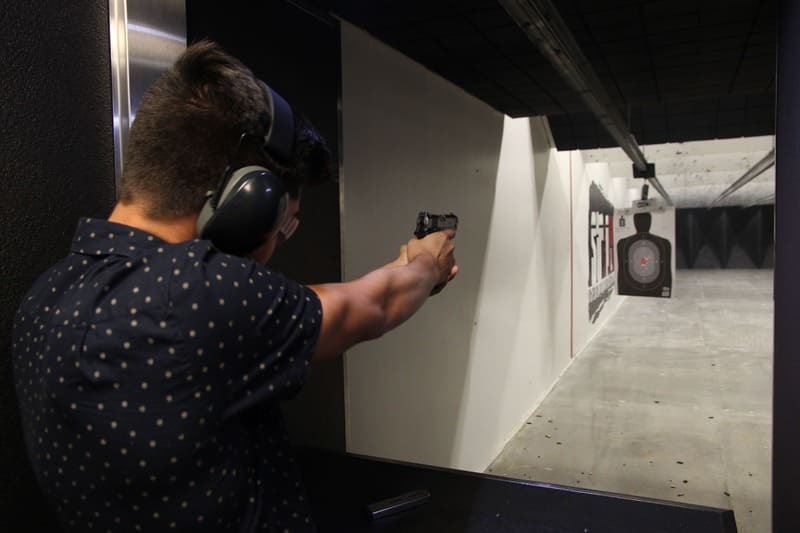
Whether you’re stepping onto a range for the very first time or you’ve been shooting for years, one fundamental question never gets old: how should you hold a handgun for maximum accuracy? Your grip is the single most important skill you can develop. Before stance, before trigger technique, before sight alignment: the grip comes first. Everything else in handgun shooting builds on top of it.
At our Las Vegas shooting range, we work with shooters of every background and skill level. The tips in this article reflect what we teach on our range, and holding a handgun correctly is always where we begin, regardless of experience.
Holding a Handgun: It Starts With Your Shooting Hand
The foundation of holding a handgun correctly begins with your dominant hand: your shooting hand. Get this part right, and the rest of your technique has something solid to build on.
Place the web of your dominant hand as high as possible on the backstrap of the grip. This high hand placement is one of the most important tips any instructor can give you. When your hand sits close to the bore axis, the gun has less leverage to rotate upward when you fire. A low grip gives recoil more room to push the muzzle skyward, which slows your follow-up shots and kills your ability to stay on target.
Wrap your fingers naturally around the front of the grip. Your trigger finger stays straight and indexed along the frame (outside the trigger guard – range safety is crucial) until you’re ready to shoot. Keep your thumb pointing forward along the frame. Your palm should make firm, full contact with the grip: no air gaps, no dead zones. Think of it as a solid handshake: purposeful pressure across the entire surface.
Before your support hand ever comes into the picture, make sure your dominant hand grip is consistent every single time you draw the handgun. Holding a handgun with a consistent grip at this stage is what separates shooters who improve quickly from those who plateau. Inconsistency here affects every pistol shot that follows.
The Two-Handed Grip: Your Best Tool for Control and Recoil Management
Once your shooting hand is properly set on the pistol, your support hand fills in everything your dominant hand leaves uncovered. This is where the two-handed grip takes shape, and it’s the technique that gives you real control over the firearm.
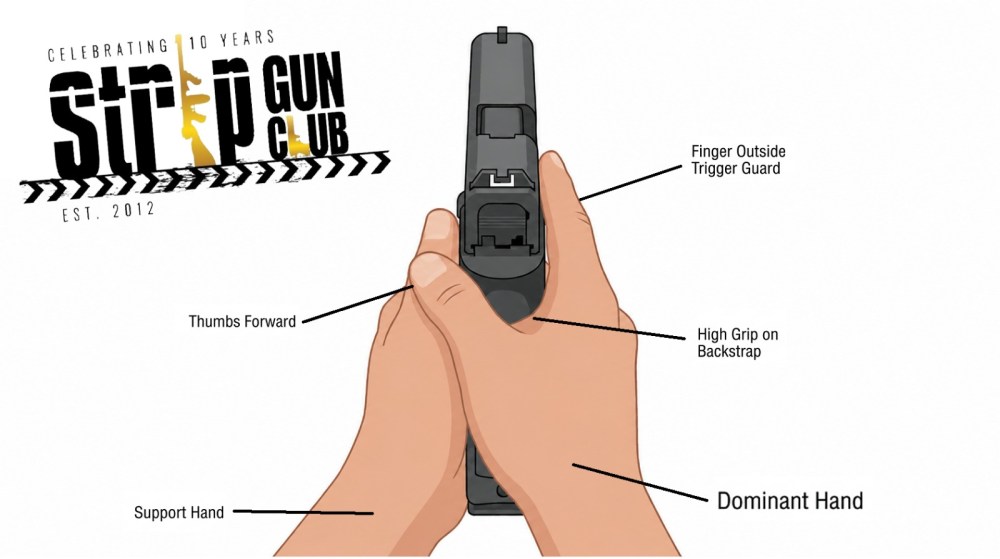
Bring your support hand up so the heel of your palm presses firmly into the open panel on the grip. Your fingers wrap over, not under, the fingers of your shooting hand. Your support hand thumb points forward, alongside the thumb of your shooting hand. This is the thumbs forward grip, and it’s the dominant technique in modern handgun shooting for good reason. It maximizes palm-to-grip contact, helps manage recoil, and gets the gun back on target faster after each shot.
Your support hand is doing more work than most new shooters realize. It should be applying roughly 60–70% of your total grip pressure. Think of your shooting hand as the steering wheel and your support hand as the engine: both are necessary, but the support hand carries the load when it comes to controlling the gun under fire.
One drill that locks this in: push forward slightly with your shooting hand while your support hand pulls rearward with equal force. This opposing isometric pressure removes slack from your arms, stabilizes the firearm, and dramatically limits movement during rapid fire. Practice this push-pull balance until it becomes second nature every time you draw.
Grip Strength: How Hard Should You Actually Squeeze?
Grip strength is one of the most misunderstood elements of handgun shooting. Many shooters assume more grip pressure equals more accuracy. It doesn’t.
Squeeze the gun too hard and your hands will begin to shake. You’ll start anticipating recoil, flinching before the trigger breaks, and your trigger pull will deteriorate. Hold the pistol too loosely and the firearm shifts position with every round, throwing your point of aim off in unpredictable directions.
The right grip pressure is often described as around a 7 out of 10: firm enough that someone couldn’t easily rotate the gun out of your hands, but relaxed enough that your fingers and arms aren’t trembling with effort. Your wrist should be solid but not locked rigid. A little flex in the wrist helps absorb recoil naturally instead of fighting it.
A useful drill: hold your pistol at full extension and have a partner try to push the muzzle off target. If they move it easily, tighten up. If your arms are shaking, ease off. You’re looking for the point where control and relaxation coexist: where the gun feels like an extension of your hand.
Front Sight Focus and Trigger Control for Maximum Accuracy
You can build the most consistent grip in the world and still shoot poorly if you mishandle the trigger. Trigger pull is where most accuracy problems live for intermediate shooters, and fixing it can transform your results immediately.
Use the center of the pad of your trigger finger: between the fingertip and the first knuckle: to press the trigger. The exact placement can vary based on individual hand and finger size, but the goal is always the same: press the trigger in a straight, rearward direction without pushing or pulling the barrel sideways. When you fire and the trigger pull yanks the muzzle offline, that’s called a “flinch,” and it’s almost always caused by rushing the trigger press.
Pull the trigger slowly and deliberately. Shooting accurately isn’t about pulling fast: it’s about pressing straight toward the target. A smooth, controlled trigger press that you don’t anticipate is the goal. This is how you trigger correctly: not with a jerk or a slap, but with a steady, intentional squeeze straight to the rear.
While you press the trigger, focus on your front sight. The front sight should be sharp and clear, centered in the notch of the rear sight, with equal space on both sides. Your target will appear slightly blurred at this focus distance: that’s not a mistake, that’s correct technique. Your eye can only sharpen one focal plane at a time, and for handgun shooting, the front sight takes priority over the target every time.
Stance, Breathing, and Maximum Accuracy on the Range
Your grip doesn’t exist on its own. Your stance is the platform underneath all of it, and how you breathe affects how steady that platform is.
Stand with your feet roughly shoulder-width apart. Put your weight on the balls of your feet and lean slightly forward at the waist: not backward. A forward lean lets your body absorb recoil rather than rocking back into it. Bend your knees slightly. Extend your arms toward the target with a soft bend at the elbows: enough to act as a shock absorber, but not so much that you’re shooting with arms folded in. The pistol should feel like a natural extension of your shoulders, not something you’re straining to hold up.
The Isosceles stance, with hips and shoulders square to the target and both arms extended evenly, is the most widely used technique for a reason. It’s symmetrical, intuitive, and well-suited to recoil management. Keep your shoulders level and down, not hunched toward your ears. Your aim should feel natural and relaxed in this position, not forced. Compared to the Weaver stance, the Isosceles stance is more commonly used among beginners and in shooting ranges.
| Stance | Body Position | Best For | Pros | Cons |
|---|---|---|---|---|
| Isosceles | Hips and shoulders square to the target, both arms extended evenly | Beginners, competitive shooting, tactical situations | Easy to learn, natural body armor coverage, strong recoil management | Can feel stiff; less effective at longer distances |
| Weaver | Dominant-side foot back, body angled 45 degrees, bent support arm | Recreational shooters, slower-paced accuracy drills | Strong push-pull grip tension, good control for heavy recoil handguns | Harder to learn, exposes less body armor, awkward when moving |
| Chapman | Similar to Weaver but dominant arm fully extended, support arm bent | Precision shooters, those transitioning from Weaver | Better sight alignment than Weaver, dominant arm acts as a solid platform | Less natural under stress, requires more practice to maintain consistency |
Control your breathing. Heavy, erratic breathing causes the handgun to rise and fall with every cycle, disrupting your aim at the worst possible moment. Slow your breath down before you fire, and break the shot on a natural pause between exhale and inhale: not a forced hold that builds tension in your arms and shoulders.
Dry Practice: Build the Grip Before You Add Live Ammo
One of the most effective ways to improve your handgun shooting doesn’t require live ammo or even leaving the house. Dry practice, working through your draw, grip, stance, sight alignment, and trigger press with an unloaded firearm, builds the muscle memory that makes good technique second nature under real conditions.
Without the noise and recoil of a live round, you can focus entirely on what your hands and fingers are doing at every stage. You’ll notice grip inconsistencies you weren’t aware of and feel exactly what your trigger finger is doing during each press. Ten minutes of dry practice daily will do more for your accuracy than a single range session once a month.
Before any dry practice drill, always verify the firearm is completely unloaded. Drop the magazine, rack the slide, and visually and physically inspect the chamber. Do this every time, without exception: no matter how many times you’ve checked it before.
Build Maximum Accuracy at Strip Gun Club in Las Vegas
Reading about how to hold a handgun is a great first step, but there’s no substitute for repetition with real firearms. The grip, the trigger pull, the stance, the sight picture, they only come together through practice on a range.
If you’re in Las Vegas, Strip Gun Club is where all of this comes to life. Whether you’re a first-timer who’s never held a pistol, a recreational shooter looking to tighten your accuracy, or an experienced firearm owner drilling the fundamentals, our arsenal has you covered. Consistent, focused range time is what turns good information into real skill.