

10mm vs 40: Which Cartridge Comes Out on Top?
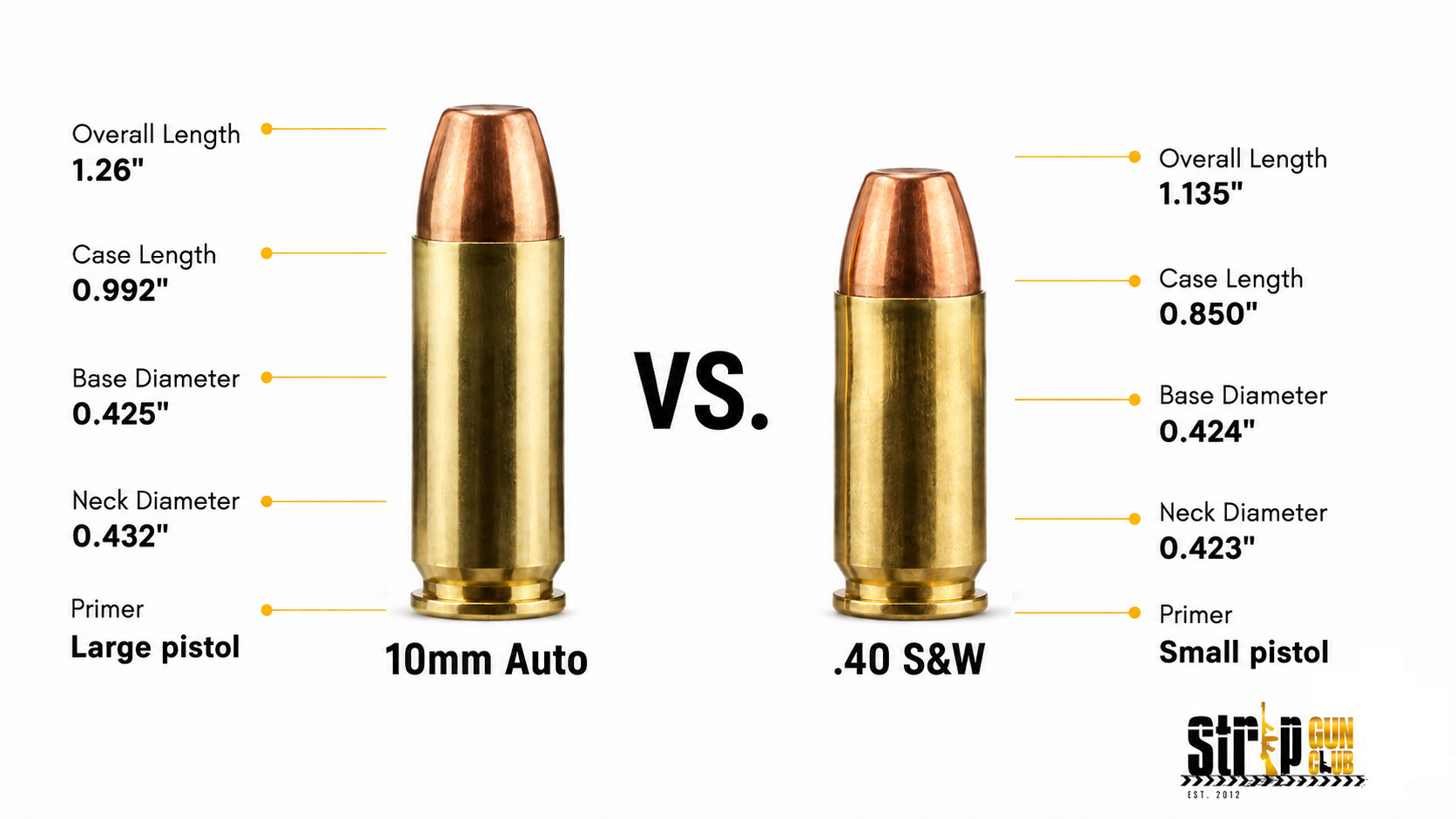
The 9mm and .45 ACP tend to hog the spotlight in ammo debates, but two rounds that share a bore diameter and a family tree deserve just as much attention: the 10mm Auto and the .40 S&W. On paper they look like close cousins. In practice, they behave very differently once the trigger breaks.
If you’ve ever stood at the counter wondering whether the extra punch of the 10mm is worth the trade-offs, this breakdown of 10mm vs 40 will walk you through the history, the ballistics, the ammo types, and the use cases so you can decide which one earns a spot in your range bag.
A Shared Bloodline
You can’t tell the 10mm vs 40 story without starting with the same shootout both cartridges trace back to.
In 1986, FBI agents in Miami, Florida, engaged two heavily armed bank robbers in a prolonged gunfight. The agents came out on top, but at a steep cost, and the Bureau’s after-action review concluded that the 9mm and .38 Special loads issued at the time hadn’t delivered the terminal performance they needed. That reckoning set off a search for more stopping power.
Enter the 10mm Auto. The round was the brainchild of Col. Jeff Cooper of Gunsite Academy fame, developed with Whit Collins and Irving Stone, and brought to production form with help from Norma using a cut-down .30 Remington case. Cooper wanted a cartridge with more velocity than the .45 ACP and more striking power than the 9mm. It debuted in the Bren Ten pistol before Colt kept it alive with the 1911 Delta Elite.
The FBI adopted the 10mm in 1989, chambered in the Smith & Wesson Model 1076. The honeymoon didn’t last. Full-power 10mm loads generated recoil that many agents struggled to control, so the Bureau downloaded the ammunition to a milder velocity. That left a lot of empty airspace in the 0.992-inch case, and Smith & Wesson saw an opportunity.
Working with Winchester, S&W shortened the case to 0.850 inch and settled on a 180-grain bullet at roughly 1,000 fps. The result launched on January 17, 1990, in Las Vegas alongside the Model 4006, the first handgun chambered for it. The .40 S&W was born, engineered to deliver FBI-spec ballistics in a package that fit 9mm-sized frames, which meant higher magazine capacity in a smaller footprint. Law enforcement embraced it, and for two decades it was the standard duty caliber across much of the country.
In short: the 10mm came first, the .40 S&W is its scaled-down descendant, and both owe their existence to the same event.
Design and Dimensional Differences
The two rounds share the same 0.424-inch case-head diameter, and both headspace off the case mouth. The bullet, neck, and base diameters are nearly identical to the naked eye. One quirky detail sets them apart under the hood: the .40 S&W uses a small pistol primer, while the 10mm uses a large pistol primer.
The real difference is length and capacity.
| Cartridge | 10mm Auto | .40 S&W |
|---|---|---|
| Overall Length | 1.26″ | 1.135″ |
| Case Length | 0.992″ | 0.850″ |
| Base Diameter | 0.425″ | 0.424″ |
| Neck Diameter | 0.432″ | 0.423″ |
| Primer | Large pistol | Small pistol |
That longer 10mm case holds more powder, and more powder is the whole ballgame when it comes to velocity and energy. If you want a deeper look at how case dimensions and projectile weight interact, our guide on ammunition grain covers the fundamentals.
Energy and Velocity: Where They Split
This is where the family resemblance ends. Muzzle velocity tells you how fast the bullet leaves the barrel, and muzzle energy — measured in foot-pounds — describes how much punch it carries downrange.
A typical 180-grain 10mm load leaves the muzzle around 1,250 fps and delivers roughly 624 ft-lbs of muzzle energy. The same-weight .40 S&W runs closer to 1,000 fps for about 400 ft-lbs. Across the board, 10mm cartridges tend to generate 400–750 ft-lbs, while .40 S&W typically produces 350–500 ft-lbs, with the 10mm leaving the muzzle roughly 100–300 fps faster depending on bullet weight.
More energy means a flatter trajectory and more authority at distance, but it comes with a cost: sharper recoil, more muzzle flip, and a louder report. The average 180-grain 10mm load produces around 11.5 ft-lbs of recoil, while the comparable .40 S&W generates a little over 5 ft-lbs — less than half. That gap is why recoil-sensitive shooters and anyone chasing fast, accurate follow-up shots often gravitate toward the .40.
Common Ammo Types
Both cartridges are offered in the same core lineup of loads, so your choice comes down to what you’re doing at the range.
Full Metal Jacket (FMJ). The workhorse for target practice and drills. FMJ rounds feed reliably in semi-autos, cost the least, and are built to penetrate rather than expand — perfect for burning through boxes on the range. If you’re new to bullet construction, our overview of bullet types breaks down what’s under the jacket.
Jacketed Hollow Point (JHP). Engineered with a nose cavity that expands on impact, creating a wider wound channel and transferring more energy. Classic loads like the Speer Gold Dot, Federal HST and Hydra-Shok, and Hornady XTP are available in both calibers. Most major manufacturers have their own trademarked JHP lines, so it pays to try a few.
Specialty and hunting loads. This is where the 10mm flexes. Because it’s a legitimate handgun-hunting round, you’ll find a deeper bench of heavy, bonded, and hard-cast options — think Buffalo Bore 220-grain hard-cast, Federal Trophy Bonded 180-grain, and Underwood’s hotter offerings. Bonded bullets keep their core and jacket locked together for deep penetration through tough media like hide and bone. The .40 has a few flat-nose hard-cast options for smaller game, but it’s a marginal hunting round by comparison.
Use Cases: Range, Hunting, and Beyond
The honest answer to “which is better” is: it depends on what you want the gun to do.
Punching paper and running drills. Either round works, but the .40 S&W is easier on the wallet and easier to shoot fast. Lower recoil means quicker sight recovery, which translates to better splits and less fatigue over a long session.
Handgun hunting. The 10mm is one of the best rimless, straight-walled pistol cartridges going. With the right bullet, it has enough energy to ethically take deer, hogs, and black bear at sensible ranges — something the .40 simply can’t match. If big-bore power interests you, you might also enjoy our comparison of .308 vs 5.56 rifle cartridges for a look at the trade-offs at the long-gun end of the spectrum.
Building skill and controllability. The .40 S&W hits a sweet spot: real power, moderate recoil, wide availability. Full-power 10mm rewards shooters who have the frame and the practice to tame it, and it punishes those who don’t.
Firearms options mirror this split. The Glock 20 and Glock 22 (10mm and .40 respectively) are the everyman standard, while Springfield Armory keeps the 10mm segment lively with the 1911 Ronin and XD-M Elite. The .40 tends to have more compact and mid-sized offerings on the shelf.
The Verdict
There’s no universal winner in the 10mm vs 40 debate — only the right fit for your goals.
Choose the 10mm if you want maximum energy, a flatter trajectory, and a genuine hunting option, and you don’t mind the extra recoil, cost, and larger firearms.
Choose the .40 S&W if you want a more affordable, more available, softer-shooting round that’s easier to run fast and still hits hard.
The best way to settle it? Shoot both. Book a package at Strip Gun Club in Las Vegas, tell our range staff which calibers you want to try, and put a few magazines through each. Feeling the difference in recoil, follow-up speed, and control firsthand beats any spec sheet.
Frequently Asked Questions
Is a 10mm more powerful than a 40 caliber?
Yes. The 10mm Auto is meaningfully more powerful. A 180-grain 10mm load delivers around 624 ft-lbs of muzzle energy versus roughly 400 ft-lbs for the same-weight .40 S&W, thanks to its longer case and larger powder charge.
Is a 10 mm equal to a 40 caliber?
Not in performance, but they share the same bullet diameter (0.400″) and case-head diameter (0.424″). The .40 S&W was designed as a shortened, reduced-power version of the 10mm, which is why some shooters jokingly call it “Short & Weak.”
Can .40 be fired from a 10mm?
It’s possible but not recommended. A .40 S&W round will chamber in a 10mm, but because both headspace off the case mouth and the .40 case is shorter, it won’t headspace correctly. Firing it can be hard on the extractor and lead to inconsistent ignition, so stick with the correct ammo for your barrel.
Is 40 and 10mm the same size?
Same diameter, different length. Both use a 0.400″ bullet and share a 0.424″ base, but the 10mm case is 0.992″ long versus the .40’s 0.850″. The 10mm is also longer overall (1.26″ vs 1.135″), which is what gives it the extra powder capacity.
Is 40 or 10mm cheaper?
The .40 S&W is typically cheaper, both per round and in firearm cost. It’s also more widely available on shelves. The 10mm isn’t hard to find, but as the larger, more specialized cartridge, it usually carries a price premium.
Why did the FBI stop using 10mm?
The FBI adopted the 10mm in 1989 but found that full-power loads produced too much recoil for many agents to shoot accurately. The Bureau downloaded the ammunition, and Smith & Wesson soon shortened the case to create the .40 S&W — delivering similar ballistics with less recoil and higher capacity. The FBI has since transitioned back to the 9mm.