

AK-47 vs AKM: What’s the Real Difference?
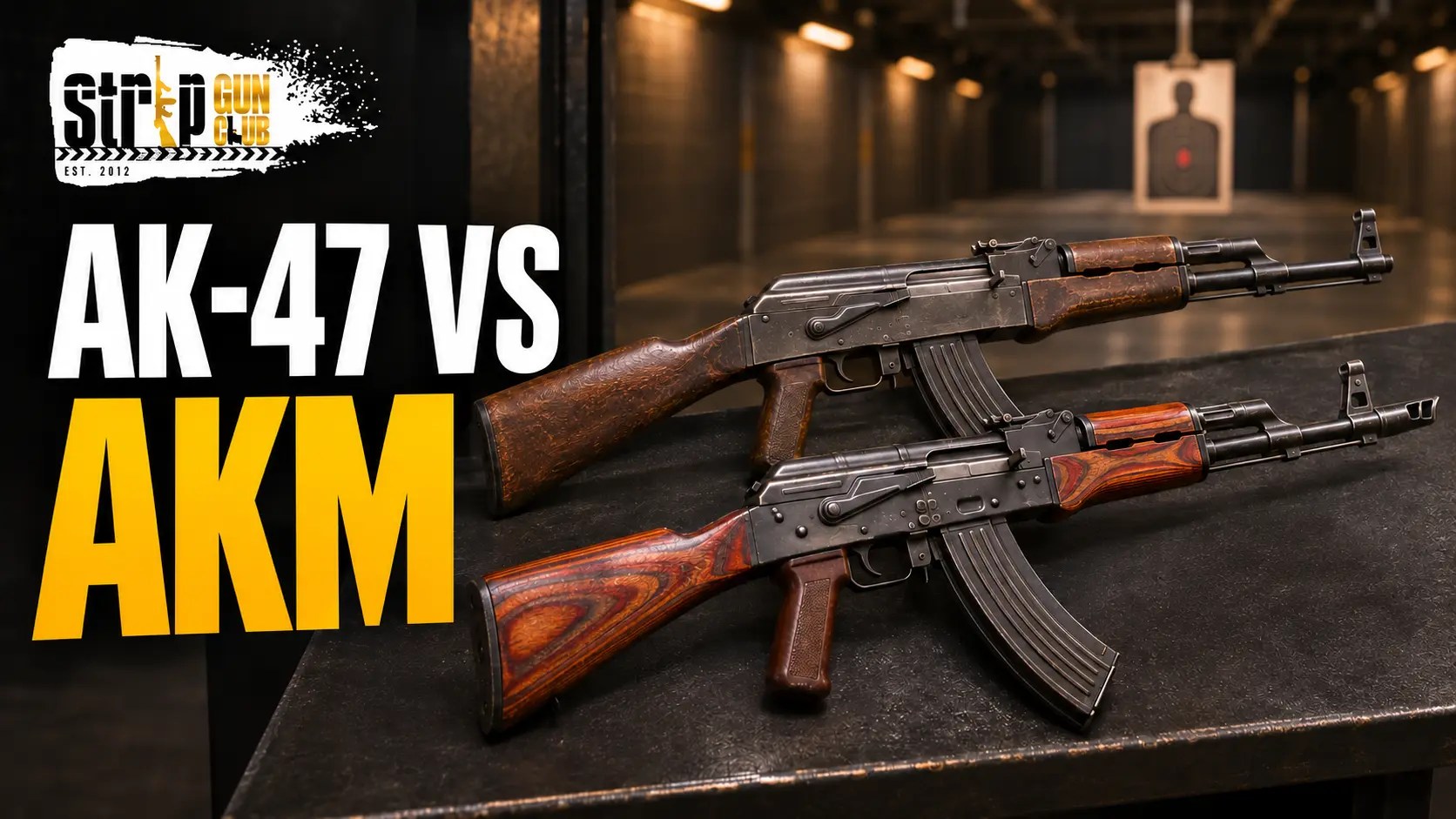
Many rifles that people call an “AK-47” are actually an AKM. The two Kalashnikovs look nearly the same from across a room, fire the same cartridge and share the same long-stroke gas system, yet collectors, historians and armorers treat them as different rifles. Here’s how they differ, how to tell them apart in about five seconds, and where the AK-74 fits into the family tree.
The short answer: the AK-47 and the AKM are both 7.62×39mm assault rifles designed by Mikhail Kalashnikov. The AK-47 most people mean (the Type 2 and Type 3) has a receiver milled from a solid block of steel. The AKM (Avtomat Kalashnikova Modernizirovanny, or “Modernized Kalashnikov”), adopted in 1959, uses a receiver stamped from 1 mm sheet steel with riveted trunnions. The AKM also added a slant muzzle compensator, a hammer-delay device usually called a rate reducer, a straighter stock and lighter parts throughout. The result was a lighter rifle that was far cheaper and faster to mass-produce.
AK-47 vs AKM at a Glance
| Feature | AK-47 (Type 2 / Type 3) | AKM |
|---|---|---|
| Adopted | 1949 (milled Type 2 from 1951) | 1959 |
| Receiver | Milled from solid steel | Stamped 1.0 mm sheet steel, riveted |
| Receiver tell | Long lightening cut, no rivets | Rivets plus a dimple above the magazine well |
| Barrel attachment | Screwed into the receiver | Pressed into the trunnion and pinned |
| Muzzle | Flat muzzle nut | Slant compensator (some early AKMs kept the nut) |
| Trigger group | No hammer delay | Rate reducer / hammer retarder |
| Top cover | Smooth | Ribbed for stiffness |
| Stock | More drop, sling swivel on the receiver | Straighter, hollowed laminate, sling on the stock |
| Lower handguard | Flat sides | Palm swells |
| Bolt carrier | Left “in the white” | Painted black, extra lightening cut |
| Weight (empty) | About 3.5 kg (7.7 lb) | About 3.3 kg (7.3 lb) |
| Cartridge | 7.62×39mm M43 | 7.62×39mm M43 |
| Barrel length | 415 mm (16.3 in) | 415 mm (16.3 in) |
| Cyclic rate | About 600 rounds/min | About 600 rounds/min |
| Magazines | Interchangeable | Interchangeable |
Where the AK-47 Came From: Type 1, Type 2 and Type 3
Kalashnikov, a former T-34 tank commander wounded in 1941, began working on a rifle for the new intermediate 7.62×39mm M43 cartridge in the mid-1940s. He openly borrowed good ideas from earlier designs, and the German StG 44 and the American M1 Garand are the two rifles most often cited as influences. His prototypes went through troop trials in 1948, and the Soviet Army formally adopted the rifle in 1949. It served alongside the SKS carbine until production caught up.
Here’s the twist most articles skip: the very first AK-47, the Type 1, had a stamped receiver. Soviet factories couldn’t yet stamp and weld the receiver to consistent quality, and reject rates climbed. Production switched to a receiver machined from a steel forging. Collectors sort the original rifles into three broad types:
- Type 1 (from 1949): stamped sheet-metal receiver, built in small numbers.
- Type 2 (about 1951–1957): heavy milled receiver with a stock socket, or “boot,” at the rear.
- Type 3 (from the mid-1950s): a refined, lighter milled receiver with a long, shallow lightening cut on each side. This is the classic AK-47 and the most common milled version.
Each type came with a fixed wooden stock or an under-folding stock (the AKS-47). These Type labels come from collectors and historians, not Soviet paperwork. Officially the rifle was simply the “Avtomat Kalashnikova.” The “47” refers to the year the design was finished.
What Changed When the AKM Arrived in 1959
Milled receivers were never Kalashnikov’s plan. They were heavy, slow to machine and wasted steel. Once Soviet industry mastered sheet-metal stamping in the late 1950s, the rifle was reworked from end to end for mass production. The AKM became the most-produced Kalashnikov of all: Soviet factories alone built more than 10 million between 1959 and 1977, and licensed and unlicensed copies were made around the world after that.
Stamped Receiver and Riveted Trunnions
The headline change is the receiver. Instead of a machined block, the AKM’s receiver is a U-shaped stamping made from smooth 1.0 mm (0.04 in) sheet steel. The front barrel trunnion and the rear stock trunnion are riveted in place, and the bolt carrier’s guide rails are spot-welded inside. A dimple pressed into each side above the magazine well helps hold the magazine steady. A thick milled receiver doesn’t need that help, which is why milled AKs have no dimples.
The barrel changed too. On the AK-47 it screws into the receiver. On the AKM it’s pressed into the front trunnion and held with a cross pin. The chrome-lined bore stayed, since Eastern Bloc ammunition was corrosively primed and the chrome resisted wear and rust in harsh field conditions.
The Slant Muzzle Compensator
The AKM introduced the angled, slant-cut compensator that’s now one of the most recognizable parts of the rifle. It vents gas up and to the right, pushing the muzzle down and left to fight the climb a right-handed shooter feels in automatic fire. It threads onto the barrel with a left-hand thread. Some early AKMs left the factory with the older flat muzzle nut instead, and the slant brake bolts straight onto an AK-47’s threads, so the muzzle device on its own proves nothing.
The “Rate Reducer”
The AKM’s trigger group gained a small hammer-delay device that sits on the same axis pin as the trigger and disconnector. Nearly everyone calls it a rate reducer, but cutting the rate of fire isn’t really its job, and the cyclic rate stays around 600 rounds per minute on both rifles. Its main purpose is safety and timing: in full auto, it holds the hammer for a split second so the rifle can’t fire until the bolt is fully locked, and it cuts down on bolt bounce. The original AK-47 could, now and then, fire slightly out of battery under full-auto vibration, and this device fixed that. A side effect is tighter bursts.
Stock, Handguards, Top Cover and Bolt Carrier
Smaller changes add up:
- Stock: longer, straighter and hollowed out to save weight. A straighter line from barrel to shoulder means less muzzle rise between shots. The sling attachment moved from the side of the receiver to the stock.
- Furniture: laminated birch plywood replaced solid wood. Laminate is cheaper and resists warping. The lower handguard gained palm swells.
- Top cover: made from thinner sheet steel, with stiffening ribs.
- Bolt carrier: an extra lightening cut, a slimmer handle and a fluted bolt stem. It’s painted black instead of left bright “in the white.”
- Gas system: the relief ports moved from a row on the gas tube to a radial pattern at the gas block.
- Recoil spring: the telescoping guide rod was replaced with a U-shaped wire guide.
Lighter Magazines
Magazines got lighter too. The early slab-sided AK-47 magazine weighed about 430 g empty. The ribbed steel AKM magazine dropped to about 330 g, and the later reddish “bakelite” magazines (actually a glass-reinforced composite) and modern polymer ones weigh roughly 250 g. Every 7.62×39 AK magazine still fits every 7.62×39 AK, including the original AK-47.
How to Tell an AK-47 From an AKM
If you’re looking at a photo or holding a rifle, check these in order:
- Look above the magazine well. A dimple on each side means stamped, which means AKM pattern. A long, shallow milled slot means a Type 3 AK-47.
- Look for rivets. Rows of rivets on the receiver side mean stamped. A clean, rivet-free receiver means milled.
- Check the top cover. Ribbed points to an AKM. Smooth points to an AK-47. (Watch out, though: the newer AK-103 also has a smooth cover.)
- Look at the lower handguard. Palm swells point to an AKM, flat sides to an AK-47.
- Ignore the muzzle device. It threads on and off, so it’s the least reliable clue.
The only true, permanent difference is the receiver: milled with an integral trunnion, or stamped with riveted trunnions. Everything else can be swapped.
Do They Shoot Differently?
Mechanically, loading and firing work the same way on both rifles. Both use a long-stroke piston fixed to the bolt carrier and a rotating bolt, and both fire the same 7.62×39mm round, typically a bullet of about 123 grains. (New to bullet weights? Here’s what grain means in ammo.)
The AKM’s changes were aimed at control in automatic fire, and the Soviet test data shows it. At 800 meters, using the Russian R50 method (the tightest 50 percent of hits), the numbers for short bursts look like this:
| Rifle | Fire mode | Vertical spread (R50) | Horizontal spread (R50) |
|---|---|---|---|
| AK-47 (1949) | Short burst | 76 cm | 89 cm |
| AKM (1959) | Short burst | 64 cm | 90 cm |
| AK-74 (1974) | Short burst | 48 cm | 64 cm |
The straighter stock and slant compensator mostly tamed vertical climb. Side-to-side spread barely moved. The real leap came with the AK-74, which is why the Soviets moved to a smaller cartridge. On a range, semi-auto, the difference between an AK-47 and an AKM is small. Both have a sharp, pushy recoil that’s noticeably heavier than a 5.56 rifle’s. If that’s new to you, our guide to understanding recoil and what to expect is a good primer.
Where the AK-74 Fits In
The AK-74 is the AKM’s successor, not a cousin of the AK-47. The Soviets adopted it in 1974 to match the trend toward small, fast rounds like the American 5.56×45mm NATO (see how 5.56 stacks up against a full-power round in our .308 vs 5.56 comparison). The key changes from the AKM:
- Cartridge: 5.45×39mm, with a light bullet leaving the muzzle at about 900 m/s, compared with roughly 715 m/s for the AKM’s 7.62×39mm.
- Muzzle brake: a large, highly effective two-chamber brake that makes the AK-74 feel remarkably flat to shoot.
- Gas block: set at about 90 degrees instead of the AKM’s slanted 45-degree block.
- Weight: about 3.1 kg (6.8 lb), lighter again than the AKM.
- Stock: a groove cut down each side, so a soldier could tell a 5.45 rifle from a 7.62 rifle by touch.
The AK-74 replaced the AKM in Soviet front-line units during the 1970s. In 1991 the AK-74M added black polymer furniture, a side-folding stock and an optics rail. Russia’s 7.62×39 line lives on in the AK-103 and AK-104, which are essentially modernized AKMs. The AK-74 is a fixture in our arsenal alongside the AK-47, so you can feel the 7.62 vs 5.45 difference for yourself.
Why Almost Every “AK-47” You’ve Seen Is an AKM
The original milled AK-47 was in front-line production for well under a decade, and very few ever reached the United States. Most survivors sit in government or museum collections. The AKM, on the other hand, was copied by more than a dozen countries: Romania (PM md. 63), Hungary (AK-63), East Germany (MPi-KM), Egypt (Maadi), Yugoslavia (Zastava M70), North Korea (Type 68) and China (the Type 56, built in both milled and stamped versions). These are the rifles seen in decades of conflict photos, film and news footage, and they’re what most people picture when they hear “AK-47.”
The same is true of the civilian market. Nearly every AK sold to American civilians is a semi-automatic rifle built on the AKM pattern: stamped receiver, riveted trunnions, semi-auto-only trigger group. Romanian WASR-10s, most US-made clones and most imports fall into this group. Milled-receiver rifles do still exist, such as Polytech Legend reproductions of the Type 3, Arsenal’s SAM7 line and some Chinese Type 56 imports. They’re the exception.
There’s one more catch. A genuine select-fire AK-47 or AKM is a machine gun under US federal law. Civilians can’t register a new one, and transferable pre-1986 examples are rare and expensive. For most people, the only practical way to fire a military-pattern Kalashnikov the way it was designed is at a licensed range.
Shoot the AK-47 and AK-74 in Las Vegas
Reading about milled receivers and slant brakes only gets you so far. To really understand what Kalashnikov built, you need to feel the 7.62×39 push of the AK-47 and then the flat, fast 5.45×39 snap of the AK-74 back to back.
At Strip Gun Club, both rifles are part of the lineup. The Rifles Package pairs the AK-47 with three of its Western rivals: the M4, the HK G36C and the FN SCAR-L. If you want the AK-74 in the same session, the Build Your Own Package lets you choose one pistol and up to six long guns, so you can line up the AK-47 and AK-74 side by side. Every package includes one-on-one instruction from our range staff, targets, ammunition, eye and ear protection, and unlimited photos and video. Complimentary transportation from the Strip is also available.
Ready to put rounds through the most famous rifle on earth? Book the Rifles Package at Strip Gun Club and shoot the AK-47 on the Las Vegas Strip.
Frequently Asked Questions
Is an AKM an AK-47?
Not technically. The AKM is the 1959 modernized successor to the AK-47. It fires the same 7.62×39mm cartridge and uses the same operating system, but it has a stamped receiver instead of a milled one, plus a slant compensator, a rate reducer and lighter parts. In everyday speech, though, “AK-47” is used for both.
What does AKM stand for?
AKM stands for Avtomat Kalashnikova Modernizirovanny, Russian for “Kalashnikov automatic rifle, modernized.”
Which is better, the AK-47 or the AKM?
For a military, the AKM: it’s lighter, cheaper to build and more controllable in automatic fire. Some collectors prefer milled AK-47s for their solid feel and craftsmanship, but there’s no meaningful reliability difference between the two.
Is a milled receiver stronger than a stamped receiver?
A milled receiver is heavier and very rigid, but a properly made stamped AKM receiver is more than strong enough for its job. The Soviets used it for decades in every climate. The stamped receiver’s real advantage is that it’s lighter and much faster to produce.
Do AK-47 and AKM magazines interchange?
Yes. Every 7.62×39mm AK magazine, from early slab-sided steel to modern polymer, fits both rifles. AK-74 magazines are a different shape for the 5.45×39mm round and don’t interchange with 7.62 rifles.
What is the difference between the AKM and the AK-74?
The AK-74 is chambered in the smaller 5.45×39mm round and has a large muzzle brake, a 90-degree gas block and grooved stocks. It recoils less and groups tighter in automatic fire. The AKM fires the heavier 7.62×39mm.
Why are real AK-47s so rare?
The milled AK-47 was only in front-line production for a few years before the AKM replaced it, and very few were exported to civilian markets. Select-fire examples in the US fall under federal machine gun law, and nearly all are held by governments, museums or licensed dealers.