

All Glock Models Chart: Every Glock Pistol by Caliber, Size, and Generation
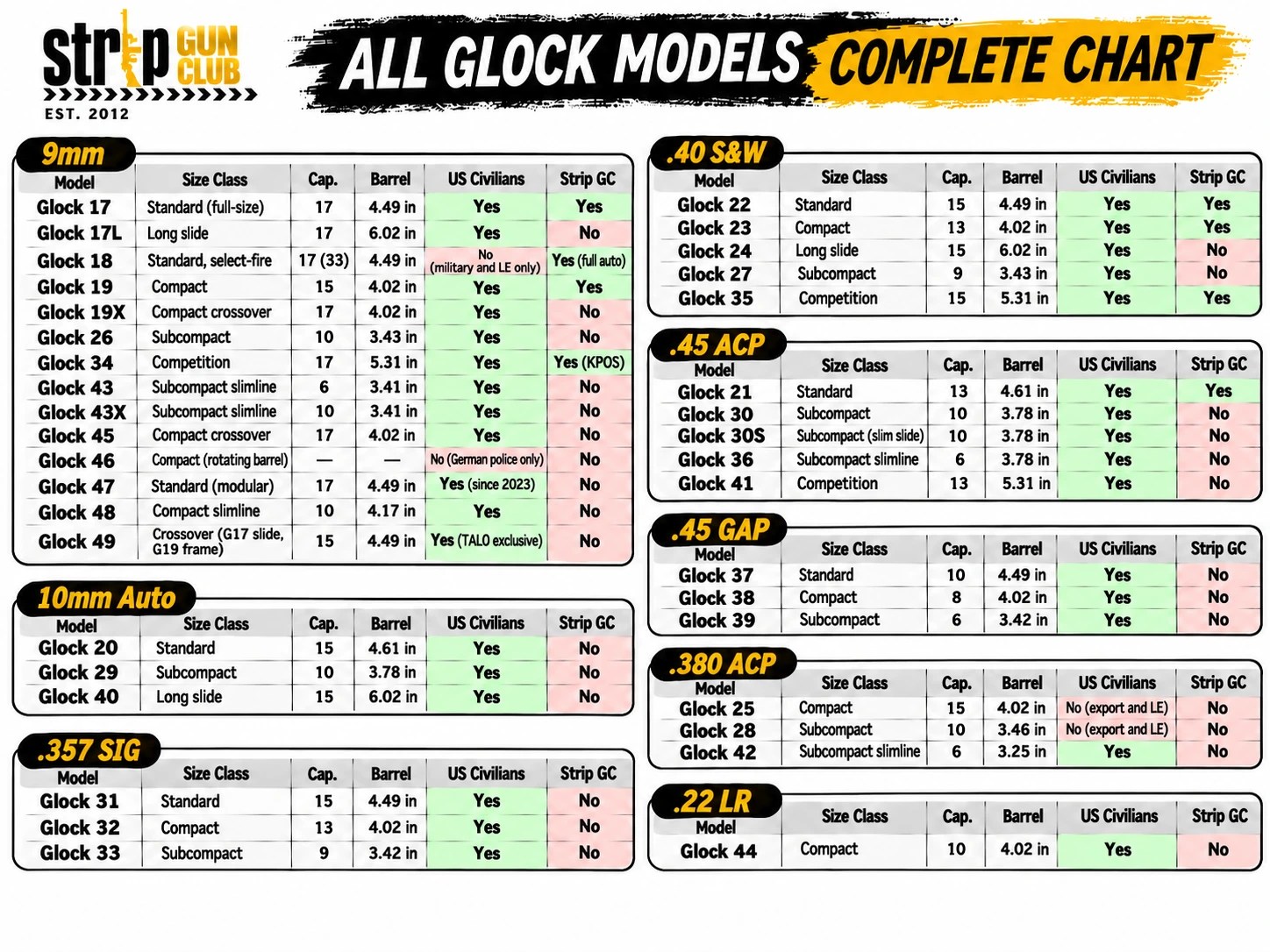
Glock has released 37 distinct pistol models since 1982: 33 numbered models running from the Glock 17 to the Glock 49, plus four lettered variants sold as models of their own (17L, 19X, 30S, and 43X). They are spread across eight calibers and eight frame categories, and from three feet away most of them look almost identical.
That is why a single chart helps. The numbers on the slide don’t tell you the caliber, the capacity, or the size, so the only reliable way to keep them straight is to see every model side by side.
Below you’ll find the complete Glock models chart, followed by how the numbering works, what each frame size means, the caliber families, the models civilians can’t buy, and every generation from Gen 1 to the new Gen 6. We’ve also marked which of these pistols you can rent and shoot at our Las Vegas shooting range.
All Glock Models Chart
The table lists all 37 Glock models in numerical order. Size classes follow Glock’s own catalog categories, capacity is the standard factory magazine, and the last column shows whether the model is part of the Strip Gun Club arsenal.
| Model | Caliber | Size Class | Standard Capacity | Barrel Length | Sold to US Civilians | In Strip Gun Club Arsenal |
|---|---|---|---|---|---|---|
| Glock 17 | 9mm | Standard (full-size) | 17 | 4.49 in | Yes | Yes |
| Glock 17L | 9mm | Long slide | 17 | 6.02 in | Yes | No |
| Glock 18 | 9mm | Standard, select-fire | 17 (33 extended) | 4.49 in | No (military and LE only) | Yes (full auto) |
| Glock 19 | 9mm | Compact | 15 | 4.02 in | Yes | Yes |
| Glock 19X | 9mm | Compact crossover | 17 | 4.02 in | Yes | No |
| Glock 20 | 10mm Auto | Standard | 15 | 4.61 in | Yes | No |
| Glock 21 | .45 ACP | Standard | 13 | 4.61 in | Yes | Yes |
| Glock 22 | .40 S&W | Standard | 15 | 4.49 in | Yes | Yes |
| Glock 23 | .40 S&W | Compact | 13 | 4.02 in | Yes | Yes |
| Glock 24 | .40 S&W | Long slide | 15 | 6.02 in | Yes | No |
| Glock 25 | .380 ACP | Compact | 15 | 4.02 in | No (export and LE) | No |
| Glock 26 | 9mm | Subcompact | 10 | 3.43 in | Yes | No |
| Glock 27 | .40 S&W | Subcompact | 9 | 3.43 in | Yes | No |
| Glock 28 | .380 ACP | Subcompact | 10 | 3.46 in | No (export and LE) | No |
| Glock 29 | 10mm Auto | Subcompact | 10 | 3.78 in | Yes | No |
| Glock 30 | .45 ACP | Subcompact | 10 | 3.78 in | Yes | No |
| Glock 30S | .45 ACP | Subcompact (slim slide) | 10 | 3.78 in | Yes | No |
| Glock 31 | .357 SIG | Standard | 15 | 4.49 in | Yes | No |
| Glock 32 | .357 SIG | Compact | 13 | 4.02 in | Yes | No |
| Glock 33 | .357 SIG | Subcompact | 9 | 3.42 in | Yes | No |
| Glock 34 | 9mm | Competition | 17 | 5.31 in | Yes | Yes (KPOS full-auto chassis) |
| Glock 35 | .40 S&W | Competition | 15 | 5.31 in | Yes | Yes |
| Glock 36 | .45 ACP | Subcompact slimline | 6 | 3.78 in | Yes | No |
| Glock 37 | .45 GAP | Standard | 10 | 4.49 in | Yes | No |
| Glock 38 | .45 GAP | Compact | 8 | 4.02 in | Yes | No |
| Glock 39 | .45 GAP | Subcompact | 6 | 3.42 in | Yes | No |
| Glock 40 | 10mm Auto | Long slide | 15 | 6.02 in | Yes | No |
| Glock 41 | .45 ACP | Competition | 13 | 5.31 in | Yes | No |
| Glock 42 | .380 ACP | Subcompact slimline | 6 | 3.25 in | Yes | No |
| Glock 43 | 9mm | Subcompact slimline | 6 | 3.41 in | Yes | No |
| Glock 43X | 9mm | Subcompact slimline | 10 | 3.41 in | Yes | No |
| Glock 44 | .22 LR | Compact | 10 | 4.02 in | Yes | No |
| Glock 45 | 9mm | Compact crossover | 17 | 4.02 in | Yes | No |
| Glock 46 | 9mm | Compact (rotating barrel) | Not published | Not published | No (German police only) | No |
| Glock 47 | 9mm | Standard (modular) | 17 | 4.49 in | Yes (since 2023) | No |
| Glock 48 | 9mm | Compact slimline | 10 | 4.17 in | Yes | No |
| Glock 49 | 9mm | Crossover (G17 slide, G19 frame) | 15 | 4.49 in | Yes (TALO exclusive) | No |
A few patterns stand out once everything sits in one place:
- 9mm dominates: 14 of the 37 models are 9mm, nearly double any other caliber.
- The numbers never skip: the line runs unbroken from 17 to 49.
- Shrinking catalog: the .40 S&W, .357 SIG, and .45 GAP families are being wound down, so some models above are easier to find used than new.
What Do Glock Model Numbers Mean?
Glock model numbers are a running sequence, not a code. They don’t tell you the caliber, the magazine capacity, or the frame size. Each new design simply received the next number in line.
The most repeated story is that the Glock 17 was named after Gaston Glock’s 17th patent, and that it holding 17 rounds is a coincidence. Glock has never published an official decoder, so the safest way to read the numbers is as an internal project counter. Either way, any pattern you try to apply falls apart quickly:
- Capacity: the Glock 19 holds 15 rounds, not 19.
- Caliber: the Glock 20 fires 10mm Auto, the Glock 40 is also 10mm, and the Glock 45 is a 9mm.
- Release order: numbers were assigned when a project started, so some later numbers reached shelves before earlier ones.
The letters after the number, on the other hand, do carry meaning:
- L: long slide, such as the Glock 17L with its 6.02 inch barrel.
- C: compensated, with ports cut through the barrel and slide to reduce muzzle rise.
- X: on the 19X, a crossover of a full-size frame and compact slide; on the 43X, a taller grip than the 43.
- S: a slimmer slide, as on the Glock 30S.
- SF: short frame, a reduced grip circumference offered on some large-frame models.
- FS: front slide serrations on Gen 5 models.
- MOS: Modular Optic System, a slide cut from the factory to mount a red dot sight.
- V: the V Series, Glock’s late 2025 redesign with anti-conversion internals.
Glock Frame Sizes Explained
Glock sorts its pistols into eight size categories, and the category tells you far more about how a gun handles than its number does. Grip length decides how much of your hand fits on the frame, and slide length decides the sight radius and barrel length. If you’re new to handguns in general, our guide to the types of pistols covers the basics before you dive into Glock’s lineup.
- Standard: the classic full-size Glock, such as the G17, G21, and G22. A 4.49 inch barrel in most calibers, the full grip, and the highest capacity for each caliber. This is the size police and militaries issue.
- Compact: slightly shorter in both slide and grip, such as the G19 and G23. A 4.02 inch barrel with a frame that still fits a full hand for most shooters.
- Compact crossover: a full-size frame with a compact slide (G19X and G45), or the reverse with a full-length slide on a compact frame (G49).
- Subcompact: the smallest double-stack Glocks, such as the G26 and G27. Barrels around 3.4 inches and a grip that leaves room for two fingers. They accept the longer magazines from their full-size siblings.
- Subcompact slimline: single-stack or slim double-stack pistols with a narrower frame, such as the G42, G43, and G43X.
- Compact slimline: the G48, which pairs a slim frame with a longer 4.17 inch barrel.
- Competition: longer slides and barrels (5.31 inches) built for sport shooters, such as the G34, G35, and G41. They usually ship with adjustable rear sights.
- Long slide: the longest Glocks made, such as the G17L, G24, and G40, with 6.02 inch barrels and the greatest distance between sights.
On the range, the bigger frames are generally easier to shoot well. A longer sight radius makes small aiming errors more visible, and a full grip gives you more control over recoil. Grip still matters on any size, so it’s worth reading up on how to hold a handgun for maximum accuracy before your first session.
Glock Models by Caliber
The easiest way to memorize the lineup is by caliber family. Within each family, Glock follows roughly the same ladder: a standard model, a compact, a subcompact, and sometimes a competition or long slide version.
9mm Luger
9mm is where Glock started and where most of its models live. The family covers the G17 (standard), G19 (compact), G26 (subcompact), G34 (competition), and G17L (long slide), plus the crossovers G19X, G45, and G49, the slimlines G43, G43X, and G48, the select-fire G18, and the contract models G46 and G47. Recoil is mild and ammunition is the cheapest of any centerfire Glock caliber, which is why most first-time shooters start here.
.40 S&W
The .40 S&W family mirrors the 9mm ladder: G22 (standard), G23 (compact), G27 (subcompact), G35 (competition), and G24 (long slide). The G22 was the standard duty pistol for a huge share of US police departments for two decades, though many agencies have since returned to 9mm. If you’re weighing the two cartridges, our .40 cal vs 9mm comparison breaks down the trade-offs.
10mm Auto
Glock’s 10mm models are the G20 (standard), G29 (subcompact), and G40 (long slide). 10mm is the most powerful cartridge in the standard lineup and is popular with hunters and backcountry shooters. It also produces noticeably more recoil than 9mm or .40, which our 10mm vs .40 guide covers in detail.
.45 ACP
The .45 ACP family includes the G21 (standard), G30 and G30S (subcompact), G36 (slimline), and G41 (competition). The G21 holds 13 rounds of .45, which is high for a cartridge that wide. For how it stacks up against Glock’s most common caliber, see .45 ACP vs 9mm.
.357 SIG
The G31 (standard), G32 (compact), and G33 (subcompact) are built on the .40 S&W frames and fire a bottlenecked, high-velocity round. It’s a niche caliber today and the family is being phased down.
.45 GAP
The G37 (standard), G38 (compact), and G39 (subcompact) fire the .45 GAP, a shorter .45 developed by Glock so a .45 caliber round could fit in a standard-size frame. It never caught on widely, and new production is winding down.
.380 ACP
The G25 (compact) and G28 (subcompact) are export and law enforcement models that aren’t sold to US civilians. The G42 is the US market .380 and the smallest, lightest Glock ever made.
.22 LR
The G44 is Glock’s only rimfire. It’s sized like a G19 but fires .22 LR with almost no recoil, which makes it the go-to Glock for low-cost training and beginners.
Glock Models You Can’t Buy in a Gun Store
Four Glock models aren’t sold to US civilians, and one more only reached the public years after its debut:
- Glock 18: the select-fire version of the G17, with a selector that switches between semi-auto and full auto at roughly 1,200 rounds per minute. It was developed at the request of the Austrian counter-terrorism unit EKO Cobra and is restricted to military and law enforcement. Licensed ranges can still let you fire one under supervision.
- Glock 25 and Glock 28: compact and subcompact .380 ACP pistols built for export markets where military calibers are restricted for civilians. Neither can be imported to the US for civilian sale.
- Glock 46: a 9mm built for German police trials and adopted by the state police of Saxony-Anhalt in 2019. It’s the only Glock with a rotating barrel instead of the usual tilting barrel, and it can be field stripped without pulling the trigger. It has never been released commercially.
- Glock 47: developed in 2019 for US Customs and Border Protection and essentially a G17 with a modular frame. It was contract-only until Glock released the G47 MOS to civilians in 2023, so it now sits on regular store shelves.
The Glock 49 is a special case on the other end: it’s fully civilian, but it launched as an exclusive through the distributor TALO, so you’ll mostly find it at TALO dealers.
Glock Generations: Gen 1 to Gen 6 and the V Series
The model number tells you what a Glock is, and the generation tells you when it was built and which features it has. Most models have gone through several generations, so a Glock 19 from 1995 and a Glock 19 from 2026 feel quite different in the hand.
| Generation | Years | What Changed |
|---|---|---|
| Gen 6 | 2026 to present | Rounded palm swell grip, built-in beavertail, flat-faced trigger, direct-mount Optic Ready System, RTF6 texture, single recoil spring. Launched with the G17, G19, and G45 |
| V Series | Late 2025 to present | Redesigned internals that block illegal auto-sear “switch” conversions. Replaced Gen 4 and Gen 5 on most models |
| Gen 5 | 2017 to 2025 | No finger grooves, flared magwell, ambidextrous slide stop, Glock Marksman Barrel, nDLC finish, later front serrations (FS) |
| Gen 4 | 2010 to 2025 | Interchangeable backstraps, larger reversible magazine release, dual recoil spring, new grip texture |
| Gen 3 | 1998 to 2025 | Accessory rail, thumb rests, finger grooves, third locking block pin for .40 S&W |
| Gen 2 | 1988 to 1998 | Checkered front and back straps, steel serial number plate, first additional models and calibers |
| Gen 1 | 1982 to 1988 | The original pebble-textured G17, no rail, no thumb rests |
The big story of the last year is the shake-up of the whole catalog. In late 2025, Glock stopped mainstream production of Gen 3, Gen 4, and Gen 5 pistols on most models and replaced them with the V Series. Then at SHOT Show in January 2026, it launched Gen 6, the first generation in years to rethink the grip and trigger.
The slimline models (G42, G43, G43X, G48, and their MOS versions) sit outside that transition and continue in their existing Gen 5 style form. Older generations remain common on the used market and in rental fleets, so don’t be surprised to see a mix at any range.
Which Glocks Can You Shoot at Strip Gun Club?
A chart tells you the specs, but it can’t tell you how a Glock feels when it goes off. Even Glock itself recommends trying several models before settling on one, because grip size and recoil feel personal. At Strip Gun Club, the only shooting range right on the Las Vegas Strip, you can put rounds through eight Glocks from the chart above:
- Glock 17: the original full-size 9mm and the benchmark every other Glock is measured against.
- Glock 19: the compact 9mm, a little shorter in the slide and grip but just as easy to shoot.
- Glock 34 KPOS: a competition-length G34 mounted in a KPOS chassis and set up for full auto fire.
- Glock 22: the full-size .40 S&W that equipped US police departments for decades.
- Glock 23: the compact .40 S&W, which lets you feel how much a shorter slide changes the recoil of the same cartridge.
- Glock 35: the competition-length .40, with a longer sight radius that rewards careful aiming.
- Glock 21: the full-size .45 ACP with 13 rounds of a heavy, slow-moving bullet.
- Glock 18: the select-fire 9mm that runs at around 1,200 rounds per minute, a model you can’t buy as a civilian but can fire legally here under supervision.
Shooting several of these back to back is the fastest way to learn what the chart can’t show. Firing the G22 and G23 side by side shows the effect of slide length, while the G17 and G21 show how much caliber changes what recoil feels like. A range safety officer stays with you the whole time, so no prior experience is needed.
Shoot Your Way Through the Glock Lineup in Las Vegas
Reading a Glock models chart is one thing; feeling the difference between a compact 9mm and a full-size .45 is another. The Pistols Package at Strip Gun Club puts a lineup of handguns in your hands in one session, with ammunition, targets, eye and ear protection, and a dedicated range safety officer included.
Every visit also comes with unlimited photos and video and free round-trip shuttle service from your hotel on the Strip. Reservations are never mixed with walk-ins, so your lane is ready when you arrive. Book your session and find out which Glock is your favorite.
Glock Models FAQ
How many Glock models are there?
There are 37 distinct Glock model designations: 33 numbered models from the Glock 17 to the Glock 49, plus the 17L, 19X, 30S, and 43X. Figures of “over 50” that you see online count each generation and MOS version as a separate model.
What do the numbers on a Glock mean?
They’re a sequence, not a code. Each new design took the next number in line, so the number says nothing about caliber, capacity, or size. That’s why the Glock 45 is a 9mm and the Glock 20 is a 10mm.
What is the most popular Glock model?
The Glock 19 is the best-selling Glock and one of the best-selling handguns in the US. The full-size Glock 17 is a close second and remains the most widely issued Glock among police and militaries worldwide.
What is the smallest Glock?
The Glock 42 in .380 ACP is the smallest and lightest Glock, with a 3.25 inch barrel and 6 round capacity. The smallest 9mm Glock is the G43.
Which Glock is fully automatic?
The Glock 18 is the only factory select-fire Glock. It fires at around 1,200 rounds per minute and is restricted to military and law enforcement, but you can shoot one legally under supervision at a licensed range like Strip Gun Club.
Is the Glock 45 a .45 caliber pistol?
No. The Glock 45 is a 9mm crossover that pairs a full-size G17 frame with a compact G19 slide. The .45 ACP models are the G21, G30, G30S, G36, and G41.
Do Glock magazines work across different models?
Within the same caliber, longer magazines fit shorter models, so a G17 magazine works in a G19 or G26 and simply sticks out below the grip. Shorter magazines won’t fully work in longer frames, and magazines don’t swap between calibers. If you’re unsure of the terminology, here’s why it’s a magazine and not a gun clip.
What is the newest Glock generation?
Gen 6, launched at SHOT Show in January 2026 with the G17, G19, and G45. It brings a reshaped grip, a flat-faced trigger, and a direct-mount optics system. Most other models moved to the V Series in late 2025.