

Types of Pistols: A Complete Guide for Shooters
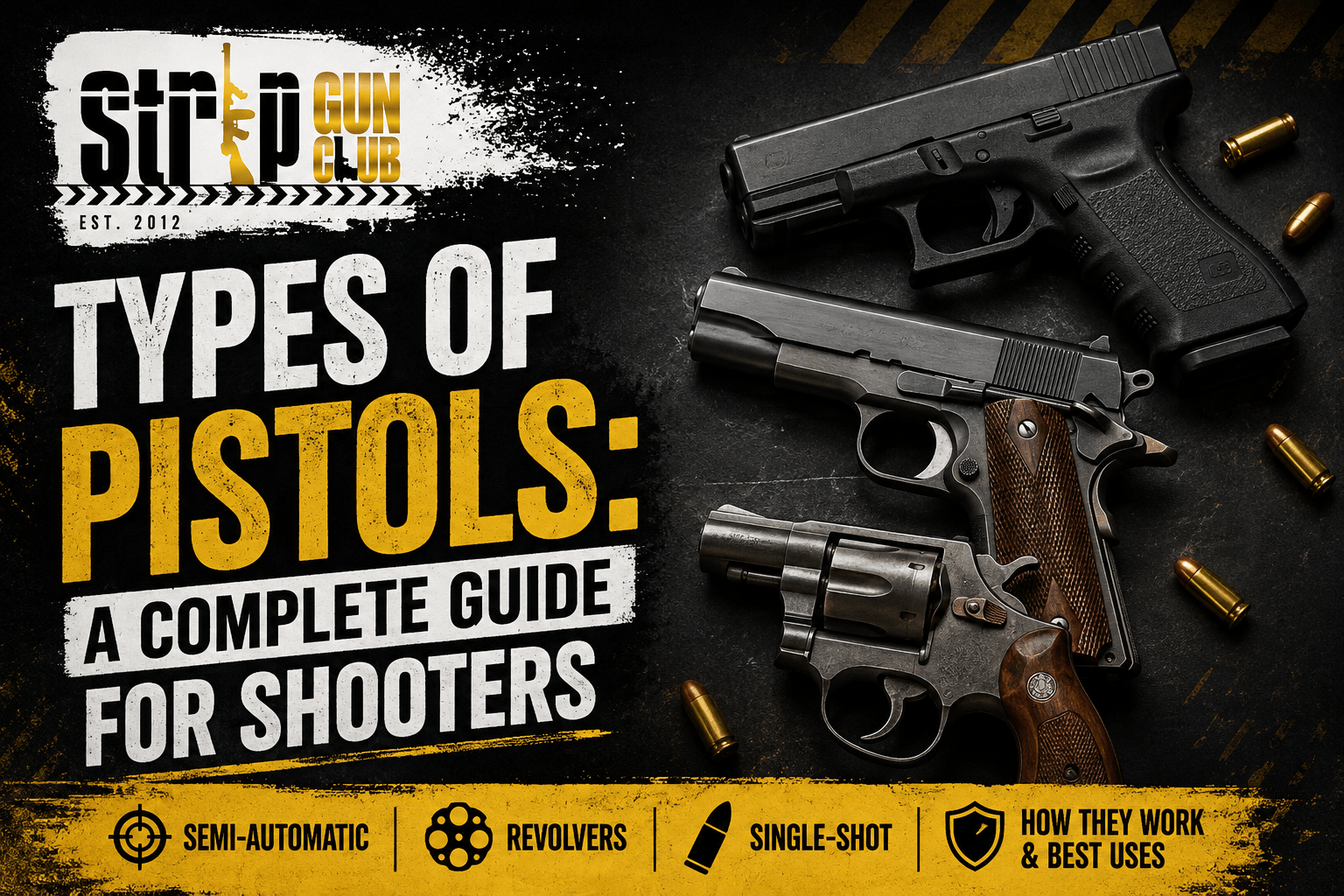
Walk up to the counter at a range and you’ll see rows of handguns behind the glass, everything from a compact 9mm to a stainless revolver to something that looks like it belongs in a Western. They’re all “pistols” in casual conversation, but the word actually covers several distinct designs, each with its own action, size class, and best use on the firing line.
If you’ve ever wondered what separates a striker-fired Glock from a single-action revolver, or why a derringer and a bolt-action handgun both count as pistols, this guide breaks it all down. By the end you’ll know the main types of pistols, how they work, and which ones are the most fun to actually put rounds through.
What Is a Pistol?
Here’s where a lot of new shooters get tripped up. The Bureau of Alcohol, Tobacco, Firearms and Explosives (ATF) defines a pistol as a firearm designed to be fired with one hand, with a chamber that is an integral part of (or permanently aligned with) the barrel.
That last part matters. A handgun is the broad category for any firearm made to be fired one-handed. A pistol is a handgun whose chamber is built into the barrel. A revolver, by contrast, feeds from separate chambers in a rotating cylinder, so by the strict legal definition a revolver is a handgun but not a pistol.
In everyday range talk, nobody’s going to correct you for calling a wheelgun a pistol, but if you want to understand the different types of guns you’ll shoot, the chamber-in-the-barrel rule is the line that divides them.
Types of Pistols by Action
The clearest way to sort pistols is by their action, meaning how the firearm loads, fires, and readies the next round. Here are the main categories.
Semi-Automatic Pistols
The semi-automatic is the most popular type of pistol in the world, and it’s what most people picture when they hear the word. A semi-auto uses the energy of each fired cartridge to eject the spent case, load a fresh round from the magazine, and reset the action. You pull the trigger once, you get one shot, and the gun is immediately ready to fire again.
Most semi-autos are recoil-operated (specifically blowback or short-recoil), while a smaller number are gas-operated. They feed from a detachable magazine that seats in the grip, which is why they carry far more ammunition than a single-shot or a revolver. That capacity, combined with fast reloads and manageable recoil, is why semi-automatic pistols dominate competition shooting, law enforcement, and the military.
Within the semi-auto family, there are two big sub-divisions worth knowing.
Striker-fired vs. hammer-fired: A hammer-fired pistol uses a spring-loaded hammer that swings forward to strike the firing pin or primer. The 1911 and the Browning Hi-Power are classic hammer-fired designs. A striker-fired pistol has no external hammer at all; instead, a spring-loaded striker is released straight into the primer. Most modern polymer-framed pistols, Glock being the obvious example, are striker-fired, which keeps the design compact and simple.
Trigger operation further splits semi-autos into a few types:
- Single Action (SA): The trigger only releases the hammer. The hammer has to be cocked first (usually by racking the slide). This gives a short, light, crisp trigger, prized by target shooters.
- Double Action (DA): The first trigger pull both cocks and releases the hammer. After that first shot, the slide cocks the hammer for you, so follow-up shots feel like single action.
- Double Action Only (DAO): Every pull cocks and releases the hammer, and the hammer can’t be manually cocked. Consistent from shot to shot, though heavier.
Whichever style you shoot, your grip does more for your accuracy than the gun itself. If you’re new, it’s worth learning how to hold a handgun for maximum accuracy before you ever worry about which trigger system you prefer.
Single-Shot and Break-Action Pistols
Before magazines and cylinders, every pistol was a single-shot. That design is still around today, mostly for hunting and precision work.
A break-action pistol hinges open so you can load a cartridge directly into the chamber, then closes for firing, exactly like a break-action shotgun. The Thompson/Center Contender is the most famous example, popular with handgun hunters because its interchangeable barrels can be swapped between rifle cartridges. Break-action pistols reload slowly and hold very little ammunition, but they’re simple, accurate, and satisfying to shoot deliberately.
Derringers
The derringer is the original pocket pistol, and it’s a category of its own. Small, usually two-barreled, and typically break-action, derringers are neither semi-autos nor revolvers. Modern makers like Bond Arms build them in calibers ranging from .22 LR up to .45 Long Colt, and some models will even chamber .410 shotshells. They’re compact, historic, and a fun novelty on the range, which is exactly why they show up in classic-firearm lineups like Strip Gun Club’s Wild West Package.
Bolt-Action Pistols
Picture a bolt-action rifle with the buttstock cut down to just a pistol grip and fore-end, and you’ve got a bolt-action pistol. They’re built for one thing: precision at distance. Chambered in rifle cartridges and drilled for a long-eye-relief scope, models like the Remington XP-100 and the Nosler Model 48 are favorites among dedicated handgun hunters. They’re heavy enough that you’ll want a bipod or shooting sticks, but few pistols can match their long-range accuracy.
Lever-Action Pistols
One of the odder entries on the list. A lever-action pistol, commonly called a “mare’s leg,” is essentially a lever-action rifle with a shortened barrel and stock. It was made famous by Steve McQueen in the 1958 series Wanted: Dead or Alive. Henry Repeating Arms produces modern versions. Because the line between a mare’s leg and an illegal short-barreled rifle depends on how the firearm was originally manufactured, this is one type where local laws are worth checking closely.
A Note on Machine Pistols
You’ll occasionally hear about fully automatic handguns, or “machine pistols,” that fire continuously while the trigger is held. These are rare, heavily regulated under federal law, and far outside what a civilian typically encounters. For nearly every shooter, “pistol” means semi-automatic, single-shot, or one of the manual actions above.
Revolvers: The Handgun That Isn’t Technically a Pistol
Even though revolvers don’t meet the legal definition of a pistol, no handgun guide is complete without them. A revolver stores its ammunition in a rotating cylinder, and each trigger pull (or hammer cock) lines up a fresh chamber with the barrel. They’ve stayed relevant for over 150 years for good reason: they’re simple, rugged, and utterly reliable.
Revolvers come in two main flavors:
- Single-action revolvers require you to manually cock the hammer before every shot, which also rotates the cylinder. This is the classic cowboy design, think Colt Peacemaker.
- Double-action revolvers can be fired by simply pulling the trigger repeatedly, which cocks the hammer and rotates the cylinder in one motion. Most modern revolvers are double-action, and they can still be cocked manually for a lighter, more precise shot.
Big-bore revolvers in .357 Magnum, .44 Magnum, and .45 Long Colt deliver a level of recoil and muzzle blast that every shooter should experience at least once.
Types of Pistols by Size
Beyond action, pistols are grouped by size, which is usually measured by barrel length (and on a pistol, remember, the barrel length includes the chamber). Size affects everything from recoil to how easy the gun is to control.
| Size Class | Typical Barrel Length | Best For |
|---|---|---|
| Pocket pistol | Under 3 inches | Ultra-compact carry, backup |
| Subcompact | 3 to 3.5 inches | Deep concealment |
| Compact | 3.5 to 4.5 inches | Everyday versatility |
| Full-size / duty | Over 4.5 inches | Range, competition, duty use |
As a rule, larger pistols are heavier, soak up more recoil, and are easier to shoot accurately, which is exactly why full-size guns rule the range and the competition circuit. Smaller pistols are easier to tuck away but demand more skill to shoot well.
Common Pistol Cartridges
Every type of pistol can be chambered in a range of cartridges, and the caliber you shoot changes the whole experience, from recoil to noise to cost per round. The most common pistol and revolver cartridges include:
- .22 Long Rifle – light recoil, cheap, perfect for learning
- .380 ACP – common in small semi-autos
- 9mm Luger – the world’s most popular pistol cartridge, balancing capacity, recoil, and control
- .40 S&W – slightly more power than 9mm with a bit more snap
- 10mm Auto – a hard-hitting round with serious recoil
- .45 ACP – the heavy, classic big-bore semi-auto cartridge
- .38 Special / .357 Magnum – revolver mainstays
- .44 Magnum – for shooters who want to feel the boom
If you’re deciding between the two most argued-about options, our breakdown of .40 cal vs. 9mm covers how they stack up on recoil, capacity, and shootability.
Which Type of Pistol Should You Shoot?
There’s no single “best” pistol, only the one that fits what you want to do. Target and competition shooters gravitate toward full-size, single-action or striker-fired semi-autos for their crisp triggers and low recoil. Handgun hunters reach for break-action or bolt-action pistols. History buffs want the 1911, the single-action revolver, and the derringer. And anyone chasing pure fun usually wants to try a little of everything.
That’s the real advantage of shooting at a range: you can put your hands on multiple types of pistols in one visit before deciding what you like. If you want to mix a pistol with rifles or submachine guns in the same session, a build-your-own package lets you sample across categories in a single trip.
Try Every Type of Pistol at Strip Gun Club
Reading about the difference between a striker-fired semi-auto and a single-action revolver is one thing. Feeling the recoil for yourself is another. At Strip Gun Club, the only luxury shooting range right on the Las Vegas Strip, our Pistols Package lets you shoot across the categories in one session, including a Glock in 9mm, .40 S&W, or .45 ACP, a suppressed HK, Glock, or FN FNX, a classic 1911 in .45 ACP, and your choice of a .357 Magnum, .44 Magnum, or .45 Long Colt revolver.
Every package includes a dedicated range safety officer, ammunition, targets, eye and ear protection, and unlimited photos and video, plus complimentary transportation on qualifying bookings. Whether it’s your first time behind a handgun or you just want to run some of the most iconic pistols ever made, this is the easiest way to experience them all.
Book the Pistols Package at Strip Gun Club
Frequently Asked Questions
Is a revolver a type of pistol?
Technically, no. A pistol has a chamber that’s integral to the barrel, while a revolver feeds from separate chambers in a rotating cylinder. Both are handguns, but under the ATF’s definition a revolver is not a pistol. In casual use, though, plenty of people group them together.
What are the most popular types of pistols?
Semi-automatic pistols, especially 9mm striker-fired models, are by far the most popular. They’re widely available, easy to shoot, and offer higher capacity than other designs. Single-shot pistols and revolvers round out the most common categories.
What’s the difference between striker-fired and hammer-fired pistols?
A hammer-fired pistol uses an external (or internal) hammer to strike the firing pin or primer. A striker-fired pistol replaces the hammer with a spring-loaded striker that hits the primer directly. Striker-fired designs are simpler and more compact, which is why most modern polymer pistols use them.
What’s the difference between single action and double action?
On a single-action pistol, the trigger only releases an already-cocked hammer, giving a short, light pull. On a double-action pistol, the trigger both cocks and releases the hammer, giving a longer, heavier pull. Many pistols combine both (double-action first shot, single-action after).
What’s a good first caliber to shoot?
.22 Long Rifle is the easiest to start with thanks to its low recoil and low cost, followed by 9mm as a step up. Both let you focus on fundamentals like grip and sight alignment without fighting heavy recoil.