

Different Types of Guns: A Beginner’s Guide to Every Firearm You Can Shoot
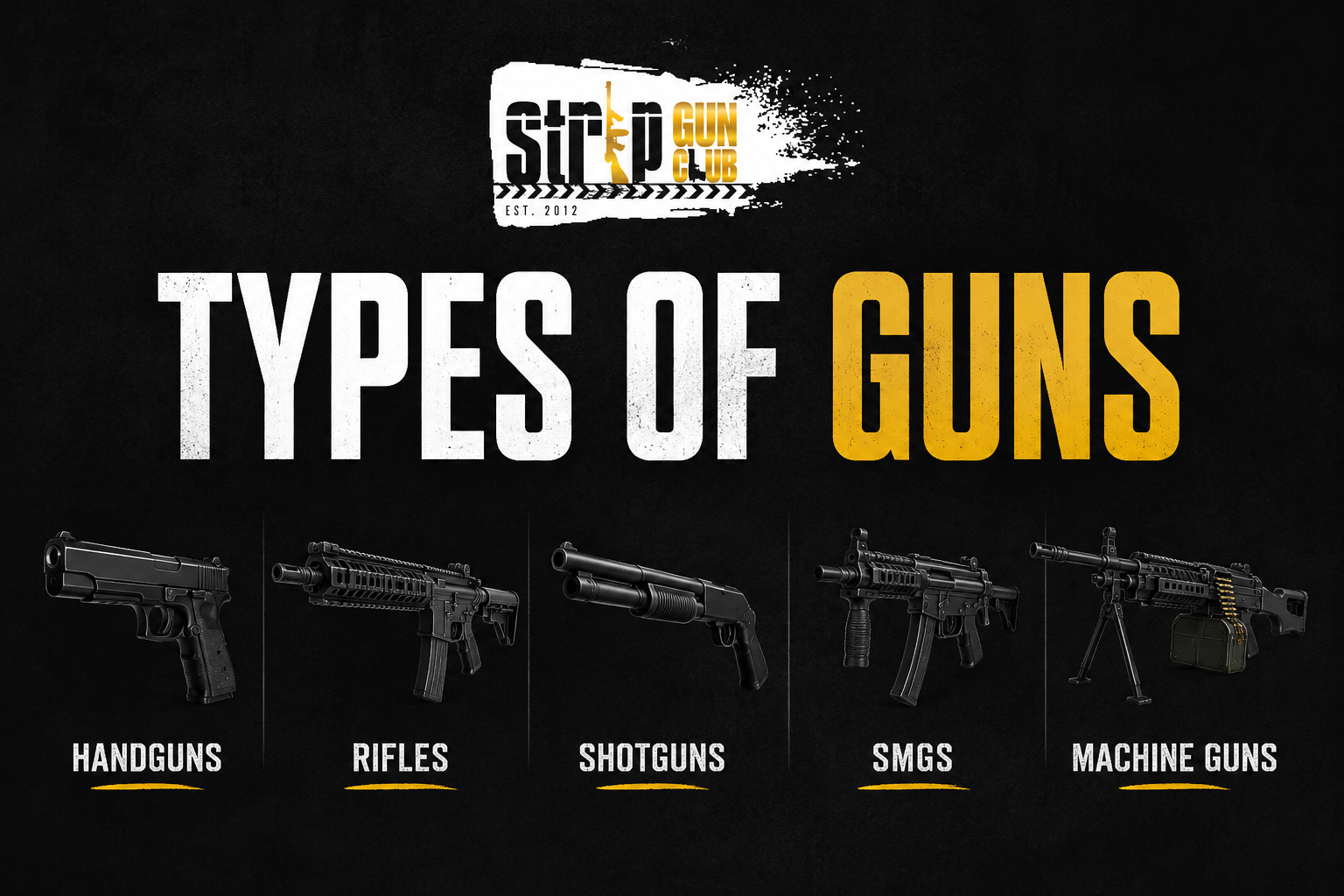
Walk up to the counter at Strip Gun Club and you’ll see dozens of firearms behind the glass, revolvers, pistols, rifles that look like they came off a movie set, shotguns, even fully automatic machine guns. If you’re new to shooting, the terminology alone can feel like a foreign language. What’s the difference between a pistol and a revolver? What does “striker-fired” even mean?
This guide breaks down all the different types of guns in plain English, so the next time you step up to the firing line, you’ll know exactly what you’re holding, and what to try next.
The Main Categories of Firearms
Almost every firearm falls into one of three broad categories:
- Handguns: designed to be fired with one or two hands, without shoulder support
- Rifles: long guns with rifled barrels, fired from the shoulder
- Shotguns: long guns with (usually) smooth barrels that fire shells containing multiple pellets or a single slug
Beyond those three, there’s a fourth category that gets people the most excited on the range: fully automatic firearms, but more on those later.
Handguns
A handgun is any firearm designed to be held and fired without bracing it against your shoulder. Handguns are compact and relatively low-powered compared to rifles. They break down into two main types: revolvers and semi-automatic pistols.
Revolvers
The revolver, sometimes called a “wheelgun”, is one of the oldest repeating firearm designs still in production. It uses a rotating cylinder, typically holding five to eight rounds, that lines up a fresh chamber with the barrel every time you cock the hammer or pull the trigger.
Revolvers are prized for their mechanical simplicity and reliability. There’s no magazine to load, no slide to rack, and very little that can go wrong. That makes them a favorite recommendation for first-time shooters. The trade-off is limited capacity and slower reloads compared to a semi-automatic.
Revolvers come in two trigger configurations:
- Single-action (SA): You must manually cock the hammer before each shot. Pulling the trigger does just one thing, it releases the hammer. Classic Old West “cowboy guns” like the Colt Single Action Army work this way, and cocking the hammer is part of the fun.
- Double-action (DA): One long trigger pull does two jobs, it cocks the hammer and releases it. Most modern revolvers, like the Smith & Wesson Model 686, are double-action but can also be thumb-cocked and fired single-action for a lighter, crisper trigger pull.
Frame size matters too. Smith & Wesson’s famous lineup runs from the small J-frame snub-nosed revolvers with barrels under three inches, through the mid-size K-frame, up to the beefier L-frame built to soak up the recoil of full-power .357 Magnum loads. Shooting a .357 Magnum revolver is a bucket-list experience, the muzzle blast and recoil are unforgettable. If you’re curious what that kick actually feels like before you try it, read our guide on understanding recoil.
Semi-Automatic Pistols
When most people say “pistol” today, they mean a semi-automatic handgun. A semi-auto uses the energy from each fired round to eject the spent casing, chamber a new round from a detachable magazine (usually housed in the grip), and re-cock the firing mechanism. One trigger pull equals one shot, but you never have to manually cycle anything between shots.
Compared to revolvers, semi-auto pistols offer higher capacity (commonly 15–17 rounds in a full-size 9mm), faster reloads, and softer felt recoil, since some of the energy is absorbed by the cycling slide. That’s why they dominate law enforcement, military, and competitive shooting.
Iconic examples you’ll find on almost every rental wall:
- The 1911: John Browning’s legendary single-action design, adopted by the U.S. Army in 1911 and chambered in .45 ACP. It served as the standard-issue American military sidearm for over 70 years, and its crisp single-action trigger still wins matches today. Curious how its big-bore cartridge stacks up against the modern standard?
- The Glock: the polymer-framed, striker-fired pistol that redefined the modern handgun. Simple, rugged, and famously reliable.
- The Beretta 92FS / M9: the double-action/single-action 9mm that replaced the 1911 in U.S. military service in 1985.
- The Desert Eagle: the chrome heavyweight of Hollywood fame, chambered in monster cartridges like .50 AE.
Hammer-Fired vs. Striker-Fired
Every cartridge fires the same way: something has to strike the primer at the base of the case hard enough to ignite the powder. How that happens splits handguns into two camps.
Hammer-fired pistols use a spring-powered hammer, visible on the back of a 1911 or Beretta, that swings forward and drives the firing pin into the primer. Hammer-fired guns can be:
- Single-action (SA): the trigger only releases the hammer (1911)
- Double-action/single-action (DA/SA): the first shot uses a long, heavy trigger pull that cocks and releases the hammer; the cycling slide then cocks the hammer for you, so every follow-up shot has a short, light single-action pull (Beretta 92, CZ 75, SIG P226)
- Double-action-only (DAO): every shot uses the full double-action pull, and the hammer never stays cocked
Striker-fired pistols eliminate the hammer entirely. A spring-loaded firing pin, the striker, sits inside the slide, partially cocked by racking the slide and fully cocked and released by the trigger pull. The result is a consistent trigger pull on every single shot, with fewer external controls to think about. Glock, Smith & Wesson M&P, and SIG P320 pistols all work this way, which is a big part of why striker-fired guns are the most popular handguns in the world right now.
Rifles
A rifle is a shoulder-fired long gun with a rifled barrel, spiral grooves cut into the bore that spin the bullet like a football, stabilizing it for accuracy at distances handguns can’t touch. Rifles are categorized mainly by their action: the mechanism that loads, fires, and ejects each cartridge.
Bolt-Action Rifles
The bolt-action is the precision shooter’s classic. The shooter manually lifts the bolt handle, pulls it rearward to eject the spent case, and pushes it forward to chamber a fresh round, like working a sturdy door bolt. Because the bolt locks rigidly into the breech, bolt-actions are exceptionally strong and accurate, which is why they remain the standard for precision rifle competition, military sniper platforms, and hunting rifles chambered in powerful calibers.
If you’ve ever wanted to reach out and ring steel through a telescopic scope, our Sniper Package puts a genuine precision rifle in your hands with an instructor coaching you through every shot.
Lever-Action Rifles
Instantly recognizable from every Western ever filmed, the lever-action uses a large metal loop behind the trigger. Cycle the lever down and forward, and it ejects the spent case and feeds a new round from a tubular magazine under the barrel. Lever guns like the Winchester 1894 and Marlin 336 date to the late 1800s but remain popular for cowboy action shooting competitions, hunting, and pure nostalgia. Running a lever gun fast is a skill, and an absolute blast.
Semi-Automatic Rifles
Semi-automatic (or “autoloading”) rifles fire one round per trigger pull and cycle the action automatically, just like a semi-auto pistol.
Two platforms dominate:
The AR-15. First things first: “AR” stands for ArmaLite Rifle, the company that developed it in the 1950s, not “assault rifle” or “automatic rifle.” Colt bought the design in 1959 and released the first semi-automatic model in 1964. Since the patents expired in the 1970s, hundreds of manufacturers have built rifles on the platform. Most AR-15s are chambered in 5.56 NATO / .223 Remington, a light-recoiling cartridge that makes the platform remarkably easy to shoot well, though variants exist in everything from .22 LR to .50 Beowulf. Its modularity is a huge part of its appeal.
The AK-47. The Soviet-designed Kalashnikov, chambered in 7.62×39mm, is the AR’s legendary counterpart. It uses a long-stroke gas piston system famous for functioning in mud, sand, and neglect that would stop lesser rifles.
Shotguns
Shotguns are long guns built around a different concept entirely: instead of one bullet, a shotgun shell typically launches a cloud of small pellets (“shot”), or alternatively a single large projectile called a slug. Most shotgun barrels are smoothbore, and their size is measured in gauge, 12 gauge being the most common, rather than caliber.
Pump-Action Shotguns
The pump-action is the shotgun most people picture. The shooter manually slides the fore-end backward to eject the spent shell and forward to chamber a new one, producing the most famous shuck-shuck sound in the firearms world. Pump guns like the Remington 870 and Mossberg 500/590 are legendarily reliable because the shooter, not the ammunition, powers the action. They’ll digest everything from light target loads to heavy magnum slugs without complaint.
Semi-Automatic Shotguns
Semi-auto shotguns cycle themselves using gas or recoil energy, starting with John Browning’s Auto-5 back in 1902. Modern examples like the Beretta 1301 and Benelli M4 deliver fast follow-up shots and noticeably softer felt recoil, since the action soaks up part of the kick. They’re favorites in 3-gun competition and among sport shooters, though they can be pickier about ammunition than a pump, since light loads may not generate enough energy to cycle the action.
Break-Action Shotguns
Break-actions hinge open like a door, exposing the chambers so you can drop shells in by hand. They come in two classic double-barrel configurations: over/under, with barrels stacked vertically, and side-by-side, the traditional “coach gun” layout. Capacity is limited to what the chambers hold, but the simplicity, reliability, and elegant handling of a fine over/under have made it the standard choice for trap, skeet, and sporting clays.
Fully Automatic Firearms: The Vegas Experience
Here’s where things get fun. A fully automatic firearm keeps firing as long as the trigger is held down and ammunition remains, versus a semi-automatic, which fires exactly one round per trigger pull.
Most people go their entire lives without ever touching one. Ranges like Strip Gun Club let you fire genuine full-autos under the supervision of a range safety officer, and it’s one of the biggest reasons shooters from all over the world make Las Vegas a destination. Ripping a magazine through a real machine gun, feeling it hammer against your shoulder as the brass fountains out, is an experience no video game can replicate. Our Machine Gun Package is built around exactly that: a curated lineup of legendary full-autos, no experience required.
Fully automatic firearms come in a few flavors:
- Submachine guns fire pistol cartridges from a compact platform, think of the Heckler & Koch MP5 in 9mm or the Thompson “Tommy Gun” in .45 ACP. Low recoil, high rate of fire, maximum grin factor.
- Machine guns proper are larger, often belt-fed weapons chambered in rifle cartridges, built for sustained fire, the M249 SAW or the iconic M240. If you want to nerd out on the differences, we’ve compared them head-to-head in M240 vs M249.
- Selective-fire rifles like the genuine M4 or M16 let the shooter switch between semi-auto and full-auto or burst modes.
Types of Guns Compared
Here’s how all the major firearm types stack up at a glance, including what each one feels like to shoot and who it’s best suited for on the range:
| Type | Classic Examples | Typical Ammo | Recoil | Rate of Fire |
|---|---|---|---|---|
| Revolver | S&W 686, Colt SAA | .38 Special, .357 Magnum | Moderate–heavy | Slow |
| Semi-auto pistol | Glock 17, 1911, Beretta 92 | 9mm, .45 ACP | Light–moderate | Fast |
| Bolt-action rifle | Remington 700 | .308 Win | Moderate | Slow |
| Lever-action rifle | Winchester 1894 | .45 Colt, .30-30 | Light–moderate | Medium |
| Semi-auto rifle | AR-15, AK-47 | 5.56 NATO, 7.62×39mm | Light | Fast |
| Pump-action shotgun | Mossberg 500, Remington 870 | 12 gauge | Heavy | Medium |
| Semi-auto shotgun | Beretta 1301, Benelli M4 | 12 gauge | Moderate | Fast |
| Break-action shotgun | Over/under, side-by-side | 12/20 gauge | Moderate–heavy | Slow |
| Submachine gun | MP5, Thompson | 9mm, .45 ACP | Light | Full-auto |
| Machine gun | M249, M240 | 5.56, 7.62 NATO | Moderate (sustained) | Full-auto |
Which Type of Gun Should You Shoot First?
If you’re brand new, here’s a proven progression:
- Start with a .22 LR pistol or rifle: Minimal recoil and noise let you focus on fundamentals, grip, sight alignment, trigger press. (Nail the basics first with our guide on how to hold a handgun for maximum accuracy.)
- Move up to a 9mm striker-fired pistol: like a Glock 17. This is the world’s most popular handgun format for a reason.
- Try a rifle in 5.56: Many new shooters are surprised by how light and manageable the recoil feels.
- Run a 12-gauge pump shotgun: to feel a completely different kind of shooting.
- Finish with full-auto: Because you’re in Vegas, and some experiences you simply can’t get back home.
Try Every Type of Gun in One Visit at Strip Gun Club
Reading about firearms is one thing. Feeling a revolver buck in your hands and holding down the trigger on a genuine machine gun for the first time, that’s something else entirely.
At Strip Gun Club, located right on the Las Vegas Strip, you can experience every category in this guide in a single session. No prior experience needed every shooter gets one-on-one guidance from a professional range safety officer from the moment you pick up the firearm to your last round downrange.
- Want the full spread? Build your ideal package across pistols, rifles, shotguns, and full-autos.
- Chasing the full-auto rush? The Machine Gun Package is a popular choice for a reason.
- First time at a range? Check out our shooting range tips for beginners so you know exactly what to expect before you walk in.
Book your shooting package today and find out which type of gun becomes your favorite.
Frequently Asked Questions
What are the main types of guns?
The three primary categories are handguns (revolvers and semi-automatic pistols), rifles (bolt-action, lever-action, and semi-automatic), and shotguns (pump-action, semi-automatic, and break-action). Fully automatic firearms, machine guns and submachine guns, form an exciting fourth category you can experience at select ranges.
What’s the difference between a pistol and a revolver?
Both are handguns. A revolver stores rounds in a rotating cylinder, while a pistol (in modern usage) is a semi-automatic that feeds from a detachable magazine in the grip and cycles itself after every shot.
Can tourists shoot machine guns in Las Vegas?
Yes. You don’t need any prior experience to fire fully automatic firearms at Strip Gun Club, every session is guided one-on-one by a range safety officer, and you can book a machine gun experience the same day you arrive in Vegas.
What gun has the least recoil for a beginner?
A .22 LR pistol or rifle has almost no recoil, making it the ideal starting point. Among centerfire options, a 9mm semi-automatic pistol is also a gentler option.