

Single Action vs Double Action: How Each Trigger Works and How It Feels on the Range
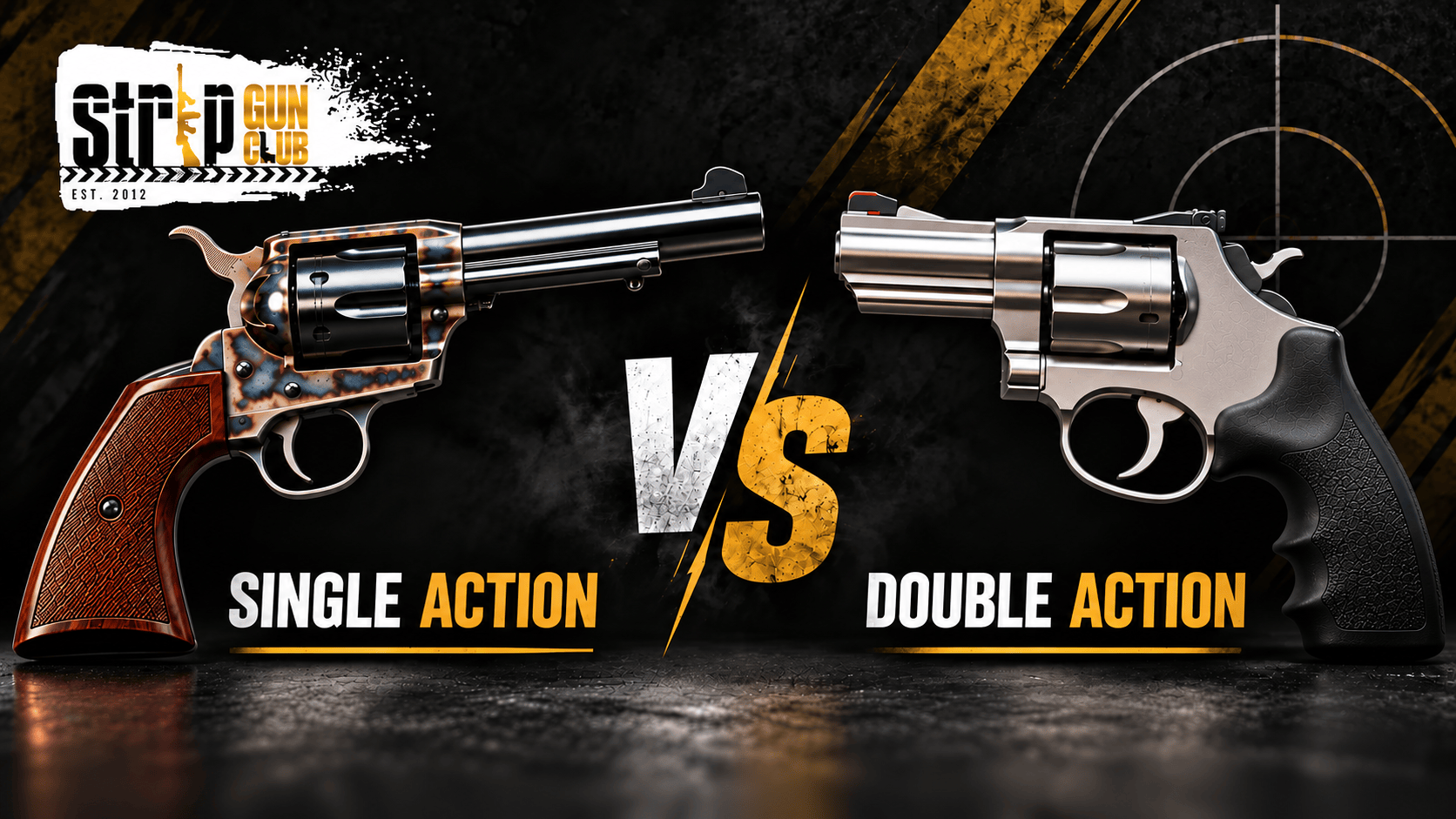
Single action vs double action comes down to one question: what does the trigger do when you press it? On a single action gun, the trigger does one thing. It releases a hammer that is already cocked. On a double action gun, the trigger does two things. It cocks the hammer and then releases it, all in one continuous pull.
That sounds like a small mechanical detail, but it changes almost everything about how a handgun shoots: how heavy the trigger feels, how far it travels, how the first shot compares to the second, and how much attention the gun demands from you. Below, we break down every action type you will run into, from the classic cowboy six-gun to the modern service pistol, and explain what each one actually feels like when you put rounds downrange.
Single Action vs Double Action: The Quick Answer
| Single Action (SA) | Double Action (DA) | |
|---|---|---|
| What the trigger does | Releases a cocked hammer | Cocks and releases the hammer |
| Hammer cocking | Manual (thumb or slide) before the first shot | Done by the trigger pull |
| Typical trigger weight | Roughly 3 to 5 lbs | Roughly 8 to 12 lbs |
| Trigger travel | Short | Long |
| Trigger break | Crisp and predictable | Longer, with more stacking before the break |
| Common examples | Colt Single Action Army, 1911, Desert Eagle | Beretta M9, SIG P226, S&W Model 29 |
There is also a third category, double action only (DAO), plus striker-fired pistols like the Glock, which sit somewhere in between. We cover both below.
How a Single Action Trigger Works
Single action is the oldest and simplest trigger design. The hammer has to be cocked before the gun can fire, and once it is cocked, the trigger has a single job: let it go. Because the trigger is not doing any of the heavy lifting, it can be light, short, and crisp.
Single Action Revolvers
The single action revolver is the gun most people picture when they think of the Old West. The Colt Single Action Army, introduced in 1873 and nicknamed the Peacemaker, is the most famous example, and modern designs like the Ruger Blackhawk and Ruger Single Six follow the same layout.
To fire a single action revolver, you:
- Cock the hammer: Pulling the hammer back with your thumb rotates the cylinder and lines up a fresh cartridge.
- Press the trigger: The trigger releases the hammer, which strikes the cartridge and fires the round.
- Repeat for every shot: The hammer stays down after firing, so you cock it again before each follow-up shot.
If you press the trigger on an uncocked single action revolver, nothing happens. Loading is different too. Instead of a cylinder that swings out, most single action revolvers use a loading gate on the side of the frame. You put the hammer on half cock, open the gate, and load one chamber at a time while rotating the cylinder by hand.
That slow, deliberate rhythm is a big part of the appeal. It is also why single action revolvers remain the centerpiece of cowboy action shooting and the Single Action Shooting Society. If you want to see where these guns came from, our post on the Wild West Package covers the frontier-era firearms in more detail.
Single Action Pistols
Semi-automatic pistols can be single action as well. The 1911, designed by John Browning and adopted by the U.S. military in 1911, is the best-known example. The Browning Hi Power, the Desert Eagle, and the FN Five-seveN are also single action designs.
With a single action pistol, you rarely cock the hammer by hand:
- Racking the slide: Chambering the first round pushes the hammer back and cocks it.
- Firing a shot: Recoil drives the slide rearward, which re-cocks the hammer automatically for the next shot.
- Every trigger press is the same: Because the slide re-cocks the hammer each time, the trigger pull stays short and light from the first shot to the last.
Since the trigger is light and the hammer sits cocked, most single action pistols use a manual thumb safety, and some add a grip safety. On a 1911, the classic way to keep it ready is “cocked and locked,” meaning the hammer is back and the thumb safety is on.
The Desert Eagle is an interesting outlier. It is a single action pistol, but it runs on a gas-operated, rotating-bolt system more like a rifle than a typical handgun. You can read more about it in our Desert Eagle spotlight.
How a Double Action Trigger Works
With a double action trigger, the first part of the trigger pull draws the hammer back and compresses the mainspring. On a revolver, it also rotates the cylinder. At the end of the pull, the trigger releases the hammer and the gun fires. Two actions, one press.
Because the trigger is doing real mechanical work, double action pulls are longer and heavier. You will often feel the pull “stack,” meaning it gets heavier just before the hammer drops.
Double Action Revolvers
Most modern revolvers are double action, and most of them can also be fired single action. That flexibility is what made the double action revolver the standard police sidearm for much of the 20th century.
A double action revolver gives you two ways to shoot:
- Double action mode: Leave the hammer down and simply pull the trigger. The long, heavy pull cocks the hammer, turns the cylinder, and fires.
- Single action mode: Thumb the hammer back first. The trigger pull becomes short and light, just like a single action revolver.
Double action revolvers also load differently. Press the cylinder release, swing the cylinder out to the side, and you can load or unload every chamber at once.
The Smith & Wesson Model 29 in .44 Magnum, made famous by Dirty Harry, is a double action revolver, as are the Smith & Wesson 686 and the massive S&W 500. If movie guns are your thing, check out our list of firearms with a Hollywood legacy.
Double Action/Single Action (DA/SA) Pistols
Many semi-automatic pistols use a hybrid system known as double action/single action, or DA/SA. Well-known examples include the Beretta 92 (adopted by the U.S. military as the M9), the SIG Sauer P226, the CZ-75, and the HK USP.
Here is how a DA/SA pistol runs:
- First shot in double action: With the hammer down, the first trigger pull is long and heavy because it cocks and releases the hammer.
- Follow-up shots in single action: The slide cycles after the first shot and leaves the hammer cocked, so every shot after that has a short, light pull.
- Decocker: Many DA/SA pistols have a decocking lever that safely lowers the hammer without firing, returning the gun to double action for the next first shot.
The tricky part is that you are managing two different trigger pulls in the same string of fire. Most new shooters notice the change immediately: the first shot takes real effort, and the second shot breaks almost before they expect it to.
Double Action Only (DAO)
Double action only guns give you the double action pull on every single shot, with no option for single action. On DAO revolvers, the hammer is bobbed, shrouded, or fully internal, so there is nothing to cock by hand. The Ruger LCR is a common example. On DAO pistols like the SIG P290, the hammer follows the slide back to the uncocked position after every shot.
The upside is consistency. Every pull feels the same. The downside is that every pull is long and heavy, which makes DAO guns some of the hardest handguns to shoot accurately.
SIG Sauer also makes a DAO variation called DAK (Double Action Kellerman). The standard pull is around 6.5 pounds, but if the shooter only lets the trigger out halfway, it resets with a heavier pull of around 8.5 pounds.
Where Striker-Fired Pistols Fit
Striker-fired pistols like the Glock 17, Glock 19, HK VP9, SIG P320, and FN 509 do not have a hammer at all. Instead, a spring-loaded striker hits the primer.
When you rack the slide on a Glock, the striker is only partially cocked. Pulling the trigger finishes cocking it and then releases it. Technically, that makes the Glock Safe Action system a form of double action only, but in practice the pull is much lighter and shorter than a traditional DAO trigger, and it is the same on every shot.
That consistency, combined with simple controls, is a big reason striker-fired pistols have become the most common handguns at ranges today. For a broader look at how pistols are categorized, see our guide to the types of pistols.
Trigger Pull Weight and Accuracy
Trigger control is the single biggest factor in handgun accuracy. You can have perfect sight alignment, but if the trigger press drags the muzzle off target, the shot goes wherever the muzzle ends up.
This is where the two actions differ most:
- Single action: A light pull of roughly 3 to 5 pounds with short travel means less movement and a cleaner break. It is generally the easier trigger to shoot precisely.
- Double action: A heavy pull of roughly 8 to 12 pounds with long travel gives your hand more time and more force to disturb the sights. New shooters often push right-handed shots low and to the left.
- DA/SA: The first shot behaves like a double action gun and every shot after behaves like a single action gun, so you are effectively learning two triggers.
- Striker-fired: Usually somewhere around 5 to 6.5 pounds, with the same feel every time.
None of this means double action guns are inaccurate. Skilled revolver shooters can be just as precise in double action as in single action. It simply takes more practice to get there. A solid grip makes a huge difference with heavier triggers, and our guide on how to hold a handgun for maximum accuracy walks through the fundamentals.
What Each Action Feels Like on the Range
Spec sheets only tell you so much. Here is what first-time shooters typically notice when they try each action back to back.
- Single action revolver: Slow and satisfying. Cocking the hammer becomes part of the rhythm, and the trigger breaks so cleanly that many shooters are surprised how easy it is to hit the target.
- Double action revolver: The long pull feels like it will never end the first few times. Then you thumb the hammer back, try single action, and the difference is night and day.
- Single action pistol: Light, crisp, and fast. Every shot feels identical, which makes it easy to settle into a steady pace.
- DA/SA pistol: The first shot takes a deliberate, heavy squeeze, and the second one breaks almost immediately. Learning that transition is the real skill with these guns.
- Striker-fired pistol: Predictable and consistent. There is no hammer to think about, just the same press shot after shot.
Action type also affects how recoil feels. A heavy double action pull on a big-bore revolver means you are already working hard before the gun goes off, while a light single action trigger lets you focus on your grip. If you are curious about what to expect, our article on understanding recoil covers it in depth.
A Short History: From the Peacemaker to the Modern Service Pistol
Every firearm was single action at first. The term “single action” only came into use once double action designs appeared to compare it against.
- 1873: Colt introduces the Single Action Army, which becomes the defining handgun of the American frontier.
- 1877: Colt releases its first double action revolver, the Model 1877, though single action revolvers remain far more common in the West for years.
- 1911: The U.S. Army adopts John Browning’s single action M1911 pistol, which serves for more than 70 years.
- 20th century: Double action revolvers such as the Smith & Wesson Model 10 and later the Model 686 become standard police sidearms.
- 1985: The U.S. military adopts the DA/SA Beretta M9 to replace the 1911.
- 1980s onward: Striker-fired pistols led by Glock spread rapidly, and in 2017 the U.S. Army adopts the striker-fired SIG P320 as the M17.
There is also a popular myth about Old West gunfighters fanning the hammer of their single action revolvers to fire rapidly. Fanning looks great in movies, but it sacrifices nearly all accuracy, which is why most historians believe working gunfighters rarely relied on it.
Which Action Should You Try First?
If you are new to handguns, there is no wrong answer, but each action teaches something different:
- Start with single action if you want the easiest trigger: A light, crisp pull lets you focus on sight alignment and grip without fighting the trigger.
- Try a double action revolver to learn trigger control: Shooting the same revolver in both modes is the fastest way to understand what “single action vs double action” really means.
- Try a DA/SA pistol once you are comfortable: Managing the first-shot transition is a great skill builder for anyone who wants to improve.
- Pick up a striker-fired pistol for consistency: It is the most common handgun type today, and a good baseline for comparing everything else.
The best way to decide which you like is to shoot them side by side under the guidance of a good instructor. Our shooting range tips can help you get the most out of your first session.
Feel the Difference Yourself at Strip Gun Club
Reading about trigger mechanics is one thing. Feeling a single action break and a double action pull in the same session is what makes it click. At Strip Gun Club, the only luxury indoor shooting range on the Las Vegas Strip, you can try both, with a dedicated range safety officer coaching you through every shot.
Our arsenal covers every action type in this article: the 1911, the Desert Eagle, and the Colt Single Action Army style revolver in .45 Long Colt for single action; the Beretta M9, SIG P226, HK USP, and .357 and .44 Magnum revolvers for double action; and a full lineup of Glock, HK, and SIG striker-fired pistols. The Pistols Package is the easiest way to compare several handguns in one visit, and every package includes ammunition, targets, eye and ear protection, unlimited photos and video, and complimentary round-trip transportation from your Strip hotel.
No experience is needed. Book your session and find out which action you prefer.
Frequently Asked Questions
What is the difference between single action and double action?
On a single action firearm, the trigger only releases a hammer that has already been cocked, either by your thumb or by the slide. On a double action firearm, the trigger both cocks and releases the hammer in one pull. As a result, single action triggers are usually lighter and shorter, while double action triggers are heavier and longer.
Is a Glock single action or double action?
Glock pistols are striker-fired. Racking the slide partially cocks the striker, and the trigger pull finishes cocking it and releases it. Glock’s Safe Action system is technically classified as double action only, but the pull is far lighter and shorter than a traditional DAO trigger.
Is the SIG P226 single action or double action?
The standard SIG P226 is a DA/SA pistol. The first shot is fired double action with a long, heavy pull, and the slide re-cocks the hammer so every following shot is single action. SIG also offers DAK and single action only versions of some P226 models.
Is single action more accurate than double action?
Single action triggers are generally easier to shoot accurately because the pull is lighter, shorter, and breaks more cleanly. That said, an experienced shooter can be just as accurate with a double action trigger. It simply takes more practice to master.
What does DA/SA mean?
DA/SA stands for double action/single action. It describes pistols where the first shot is fired in double action and every subsequent shot is fired in single action because the slide re-cocks the hammer after each shot. The Beretta M9 and CZ-75 are well-known examples.
Can you fire a double action revolver in single action?
Yes. Most double action revolvers have an exposed hammer that you can cock by hand. Once the hammer is cocked, the trigger pull becomes short and light, exactly like a single action revolver. Double action only revolvers with hidden or bobbed hammers are the exception.
Did cowboys use single action or double action revolvers?
Most Old West gunfighters carried single action revolvers like the Colt Single Action Army. Double action revolvers such as the Colt Model 1877 were available from the late 1870s onward, but single action designs remained far more common on the frontier.
Is a single action or double action handgun better for beginners?
Many instructors like to start beginners on a single action because the light trigger makes it easier to learn sight alignment and grip. Others prefer striker-fired pistols for their consistent pull. The best approach is to try several types with an instructor and see which feels most natural to you.