

What Is a PCC Gun? Pistol Caliber Carbines Explained
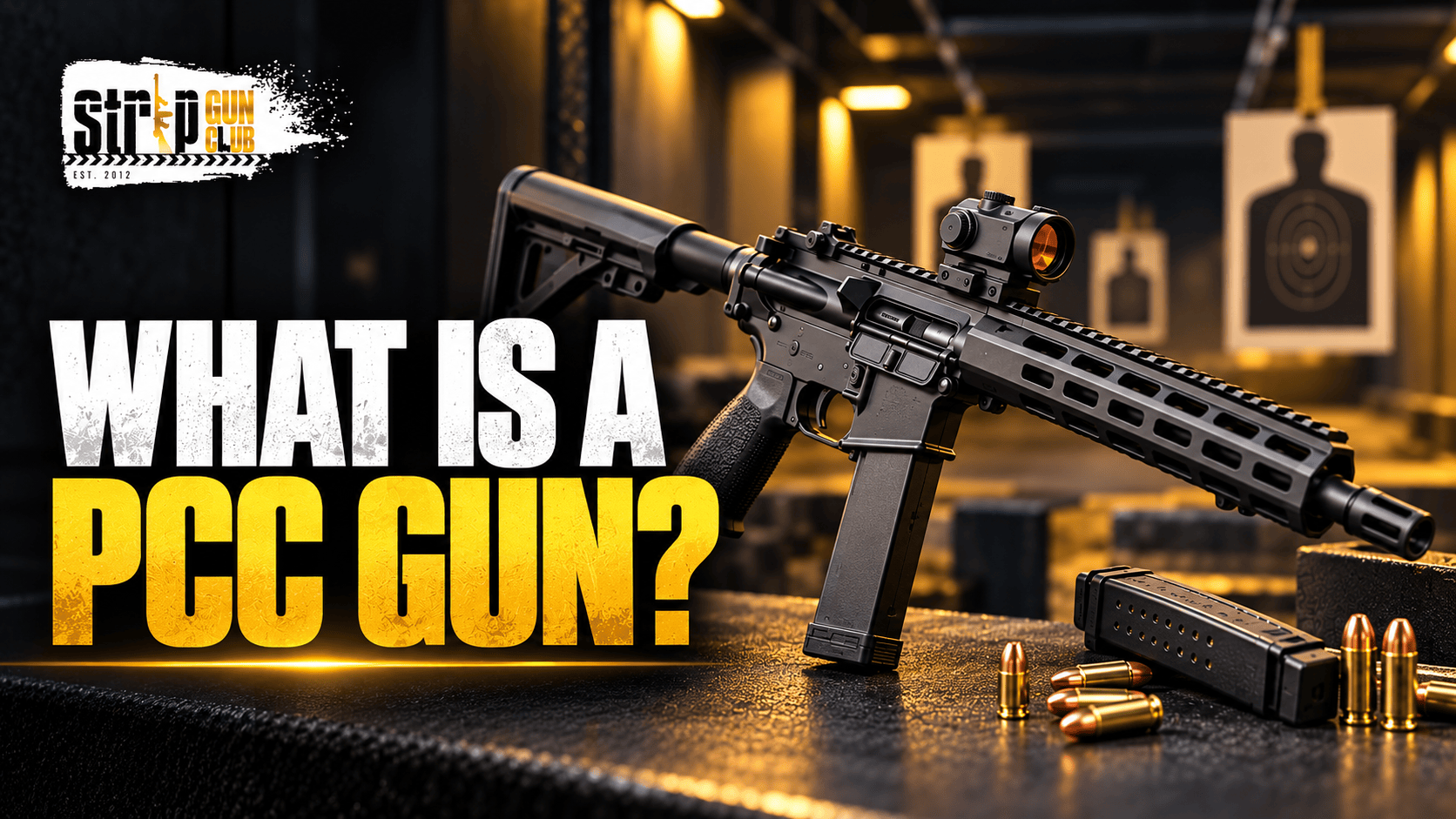
A PCC gun is a pistol caliber carbine: a long gun with a shoulder stock and a longer barrel that fires handgun ammunition such as 9mm, .40 S&W, or .45 ACP. It handles like a rifle but shoots a pistol cartridge, so you get rifle-style stability and accuracy with the low muzzle blast and cheaper ammo of a handgun round.
That simple idea covers a surprising range of guns. An 1873 lever action, a semi-auto version of the HK MP5, and a folding carbine that fits in a backpack are all PCCs. Below, we break down what makes a gun a PCC, how it compares to pistols, rifles, and submachine guns, and why so many shooters have fallen for them.
What Does PCC Stand For?
PCC stands for pistol caliber carbine. Each part of the name tells you something:
- Pistol caliber: The gun fires a cartridge originally designed for handguns. 9mm is by far the most common, followed by .40 S&W, .45 ACP, and 10mm Auto.
- Carbine: Traditionally, a carbine is a long gun with a shorter barrel than a full-size rifle. With PCCs the word is used more loosely to mean a shoulder-fired gun, since a PCC’s barrel is actually much longer than a pistol’s.
Put together, a PCC sits right between the two big families of firearms: handguns and long guns. If you want a refresher on how those families break down, our guide to the different types of guns covers the basics.
How a PCC Works
Take a 9mm cartridge, put it in a gun with a stock, a longer barrel, and a rifle-style sighting plane, and you have a PCC. That combination changes both how the round performs and how the gun feels in your hands.
Three Points of Contact
A handgun is held with your hands only. A PCC adds a third point of contact: your shoulder. Bracing the stock against your body and resting your cheek on it makes it far easier to keep the sights steady. That is why most first-time shooters group tighter with a 9mm carbine than with a 9mm pistol on the same day at the range.
Longer Barrel, More Velocity
A typical pistol has a 3 to 5 inch barrel. Most PCCs run somewhere between 8 and 16 inches. The extra length gives the powder gas more time to push the bullet, so the same 9mm load leaves a carbine noticeably faster, often 100 to 250 feet per second more than from a full-size handgun, depending on the load. It is a real gain, but it does not turn a pistol round into a rifle round.
Barrel Length and Legal Classification
In the United States, a gun built with a shoulder stock counts as a rifle only if its barrel is at least 16 inches long and the gun measures at least 26 inches overall. A stocked gun with a shorter barrel is a short-barreled rifle (SBR), which falls under the National Firearms Act and must be registered with the ATF.
That is why many compact PCCs, such as the SIG MPX K and the Springfield Armory Kuna, are sold as “pistols” with a stabilizing brace instead of a stock. Brace regulations have shifted several times in recent years, so anyone buying one should check current federal and state rules first.
Common PCC Calibers
Almost any handgun cartridge can end up in a carbine, but a handful dominate the market:
- 9mm (9x19mm Parabellum): The default PCC round. It is cheap, available everywhere, mild in recoil, and supported by more magazines and guns than anything else. When USPSA added PCC to its competitions, 9mm quickly became the near-universal choice.
- .45 ACP: A big, slow bullet that is naturally subsonic in most loads, which makes it a favorite for suppressed carbines. See how it stacks up in our .45 ACP vs 9mm comparison.
- .40 S&W: A middle ground between 9mm and .45 ACP, offered in carbines like the HK UMP and the Ruger PC Carbine.
- 10mm Auto: The hot rod of the group. A longer barrel lets 10mm reach some impressive velocities.
- Revolver cartridges (.357 Magnum, .44 Magnum, .45 Colt): Usually found in lever actions. These rounds gain a lot of speed from a rifle-length barrel.
- 5.7x28mm: Small, fast, and flat-shooting. Guns built around it, like the FN P90, are usually called personal defense weapons (PDWs) rather than PCCs, though the line is blurry.
PCC Operating Systems
The operating system is how a gun uses the energy of each shot to eject the empty case and load the next round. It has a big effect on how a PCC feels when you shoot it.
- Direct blowback: The most common and simplest design. A heavy bolt and a stiff spring hold the action closed, and the pressure of the shot pushes the bolt back. It works because pistol cartridges run at much lower pressure than rifle rounds. The tradeoff is a sharper recoil impulse. The Ruger PC Carbine, S&W M&P FPC, and CZ Scorpion all use it.
- Roller-delayed blowback: Made famous by the HK MP5. Two rollers in the bolt slow it down for a split second before it unlocks, which gives an exceptionally soft, flat recoil impulse. The HK SP5, Century Arms AP5, and Springfield Armory Kuna use it. Our MP5 spotlight explains why this design is still the benchmark.
- Other delayed blowback systems: Newer designs chase the same smoothness in different ways, such as CMMG’s radial delayed blowback, LWRC’s chamber ring delay, and the Kriss Vector’s unique recoil-redirecting action.
- Gas piston: Borrowed from rifles. The SIG MPX uses a short-stroke piston for a soft, clean-running action.
- Lever action: The original PCC. You cycle each round by hand with the lever, as on a Winchester 1873 or a modern Henry Big Boy.
PCC vs Pistol vs Rifle vs Submachine Gun
A lot of confusion around PCCs comes from how close they sit to other categories. Here is how they compare at a glance:
| Type | Ammunition | Typical barrel | Fire mode | Held with |
|---|---|---|---|---|
| Pistol | Handgun cartridge | 3 to 5 in | Semi-auto or revolver | Hands only |
| PCC | Handgun cartridge | 8 to 16+ in | Semi-auto or lever action | Shoulder and hands |
| Submachine gun (SMG) | Handgun cartridge | 4 to 10 in | Fully automatic (select fire) | Shoulder and hands |
| PDW | Small high-velocity round (5.7x28mm, 4.6x30mm) | 4 to 10 in | Often select fire | Shoulder and hands |
| Rifle or carbine (AR-15) | Rifle cartridge (5.56 NATO) | 16+ in | Semi-auto | Shoulder and hands |
PCC vs Pistol
Both fire the same ammunition, but the PCC wins on stability, accuracy, sight radius, and magazine capacity, with 30-round magazines being common. The pistol wins on size and weight. If you can hit well with a 9mm pistol at 15 yards, you can usually hit well with a 9mm carbine at 50.
PCC vs AR-15
Many PCCs copy AR-15 ergonomics so closely that the controls are identical, but the ammunition is a different world. A 5.56 rifle round travels far faster and carries much more energy at distance, while a 9mm PCC gives you quieter shooting, less blast, and cheaper practice. For more on how rifle cartridges behave, see our .308 vs 5.56 breakdown.
PCC vs Submachine Gun
This is the distinction most people miss. A submachine gun is also a shoulder-fired gun chambered in a pistol cartridge, but it is capable of fully automatic fire. A PCC is semi-automatic (or manually operated), firing one round per trigger pull.
In practice, many popular PCCs are civilian semi-auto versions of famous submachine guns. The HK SP5 is a semi-auto MP5, and the CZ Scorpion 3+ is a semi-auto version of the Scorpion EVO 3. Because new machine guns cannot be sold to civilians in the U.S., the full-auto originals are out of reach for nearly everyone, which is a big reason ranges with real SMGs are so popular. Our article on the evolution of submachine guns covers how these guns developed.
A Short History of the PCC
PCCs feel like a recent trend, but the idea is about 150 years old:
- 1873: Winchester introduced its Model 1873 lever action in .44-40, and Colt soon chambered its Single Action Army revolver in the same cartridge. A frontier traveler could carry one box of ammunition for both guns. Our post on the Wild West package covers the guns of that era.
- 1910s to 1940s: Submachine guns like the German MP18 and the American Thompson put pistol cartridges into fully automatic, shoulder-fired weapons. The Thompson’s .45 ACP chambering made it famous in the Prohibition era and in World War II.
- Post-war years: The Sten, Sterling, Uzi, and later the HK MP5 refined the pistol-caliber shoulder gun for military and police use.
- 1980s and 1990s: Semi-auto civilian carbines took off. The Marlin Camp 9 and Camp 45, built from 1985 to 1999, used the same magazines as popular handguns, and budget options like the Hi-Point carbine followed.
- 2001: The KelTec Sub2000 introduced the folding PCC, a design that is still copied today.
- 2016: USPSA, one of the largest action shooting organizations in the U.S., launched a Pistol Caliber Carbine division on July 1, 2016. IDPA followed in 2017. USPSA rules require a shoulder stock and cap PCC velocity at 1,600 feet per second.
- Today: Manufacturers compete hard in the category, from budget blowback guns to premium roller-delayed carbines. The U.S. Army even selected the B&T APC9, a pistol-caliber gun, for its compact subgun needs.
Why Shooters Love PCCs
- Easy to shoot well: The stock and longer sight radius make hitting targets much easier than with a handgun, which is why PCCs are a popular first long gun for newer shooters.
- Cheaper to shoot: 9mm practice ammo is consistently one of the most affordable centerfire rounds, so a day with a PCC usually costs less than a day with an AR-15.
- Lower muzzle blast: Pistol rounds produce far less noise, flash, and concussion than rifle rounds. Many indoor ranges that restrict rifle calibers welcome PCCs.
- Magazine sharing: Many PCCs accept the same magazines as popular pistols, including Glock, S&W M&P, and SIG patterns. (And yes, they are magazines, not clips. Our guide to what a gun clip is explains the difference.)
- Suppressor friendly: Heavy 9mm loads and most .45 ACP loads stay below the speed of sound from a carbine barrel, so a suppressed PCC can be remarkably quiet. If bullet weights confuse you, our explainer on what grain means in ammo helps.
- Competition ready: PCC is now one of the fastest-growing divisions in USPSA, Steel Challenge, and IDPA matches.
PCC Drawbacks and Common Myths
PCCs are not perfect, and a few myths deserve some clarification:
- Less power than a rifle: Even with the velocity boost, a 9mm carbine carries a fraction of the energy of a 5.56 rifle, and that gap grows with distance.
- Limited practical range: Most PCC shooting happens inside 100 yards. Past that, the heavier, slower pistol bullet drops quickly.
- Not always softer than an AR-15: Many people assume a pistol round always means less recoil. A 9mm blowback carbine, with its heavy bolt slamming back and forth, can actually feel punchier than a gas-operated 5.56 AR. Roller-delayed and piston guns feel much smoother. Our guide to understanding recoil explains what you actually feel when a gun fires.
- Bigger than a pistol: A PCC is still a long gun, so it gives up the compact size of a handgun.
Popular PCC Examples
If you want to see what the category looks like in practice, these models come up again and again:
- HK SP5 and Century Arms AP5: Semi-auto versions of the MP5 and the gold standard for soft-shooting roller-delayed carbines.
- SIG Sauer MPX: A gas-piston PCC with AR-15 style controls, offered in the compact MPX K and the tiny Copperhead.
- CZ Scorpion 3+: The semi-auto version of the Scorpion EVO 3 submachine gun, with cheap and plentiful magazines.
- Ruger PC Carbine: An affordable takedown carbine with swappable magwells for Ruger or Glock magazines.
- Smith & Wesson M&P FPC: A side-folding carbine that runs M&P pistol magazines and stores spares in its stock.
- KelTec Sub2000: The original folding PCC, now in its third generation.
- Springfield Armory Kuna: A modern roller-delayed design with AR-style controls at a reasonable price.
- B&T APC9: A Swiss premium carbine with U.S. Army pedigree.
- CMMG Banshee: An AR-style PCC available in 10mm, among other calibers. Curious how 10mm compares to its cousin? Read our 10mm vs .40 guide.
- Henry Homesteader: A wood-stocked 9mm carbine that proves PCCs do not have to look tactical.
Shoot the Full-Auto Versions in Las Vegas
Owning a PCC means owning a semi-auto gun. The full-auto submachine guns that inspired them, like the MP5, UMP, and P90, are essentially impossible for most civilians to buy. You can still fire them, though, legally and with no license or experience required.
At Strip Gun Club, the only luxury indoor shooting range on the Las Vegas Strip, our Submachine Guns Package puts three handheld full-autos in your hands:
- HK MP5 (9mm): The roller-delayed legend behind today’s most popular PCCs, with 50 rounds.
- HK UMP (.40 S&W or .45 ACP, your choice): A slower, heavier full-auto thump, with 50 rounds.
- FN P90 (5.7x28mm): The bullpup PDW with a top-mounted 50-round magazine, with 50 rounds.
That is 150 rounds of full-auto fire, with a dedicated range safety officer, eye and ear protection, targets, unlimited photos and video, and complimentary round-trip transportation from Strip and downtown hotels. Shooters ages 10 and up can join with a parent or legal guardian. Our arsenal also includes the Uzi, Thompson, Sterling, CZ Scorpion EVO 3, and lever actions in .45 Colt and .357 Magnum if you want to try the original PCC.
FAQ
What does PCC stand for in guns?
PCC stands for pistol caliber carbine. It is a shoulder-fired long gun chambered for a handgun cartridge, most commonly 9mm.
Is a PCC a rifle or a pistol?
It depends on the configuration. A PCC with a shoulder stock and a barrel of at least 16 inches is legally a rifle. Compact versions with a stabilizing brace instead of a stock are typically sold as pistols, and stocked guns with barrels under 16 inches are short-barreled rifles that must be registered with the ATF.
Is a PCC the same as a submachine gun?
No. Both fire pistol cartridges from a shoulder-fired platform, but a submachine gun is capable of fully automatic fire. A PCC is semi-automatic or manually operated. Many PCCs are semi-auto civilian versions of famous submachine guns like the MP5.
What is the effective range of a 9mm PCC?
Most shooters use a 9mm PCC inside 100 yards, where it is accurate and easy to hit with. It can reach farther, but the bullet drops quickly and loses energy past that distance.
Does a PCC have less recoil than an AR-15?
Not always. A 9mm PCC produces much less muzzle blast than a 5.56 AR-15, but a direct blowback PCC can have a sharper recoil impulse because of its heavy bolt. Roller-delayed and gas-piston PCCs are noticeably softer.
Is a PCC good for beginners?
Yes. The stock gives new shooters more stability than a handgun, recoil and noise are manageable, and ammunition is affordable. Many shooters find it the easiest gun to hit targets with on their first range visit.
Can you shoot a PCC at an indoor range?
Usually, yes. Most indoor ranges allow pistol caliber carbines because they fire handgun ammunition, even when they restrict rifle calibers. Always check with the range before you go.