

45 ACP vs 9mm: The Complete Breakdown
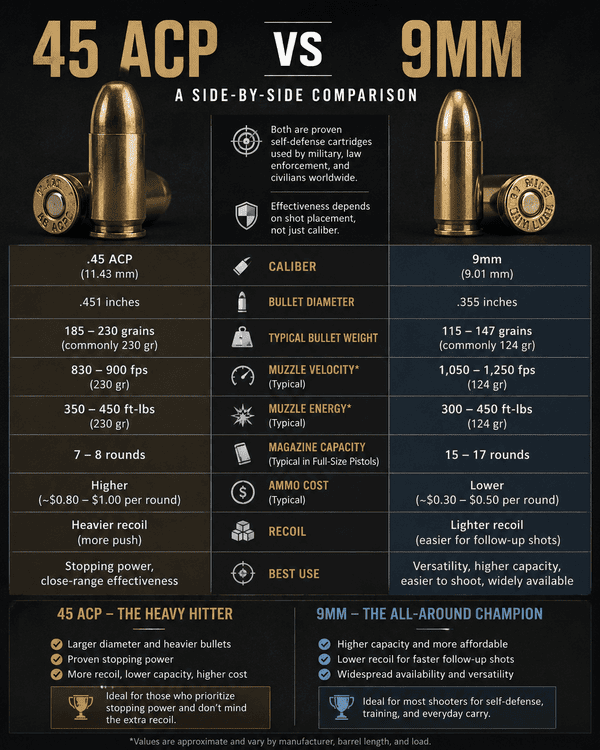
Few debates in the firearm world run as hot as 45 acp vs 9mm. For over a century, shooters argued over which handgun cartridge wins for self defense and daily carry. Both rounds have loyal fans and saw heavy military use. This guide breaks the differences in ballistics, recoil, capacity, and stopping power so you pick the caliber that fits you.
New shooter with a first pistol, or a veteran owner eyeing another firearm? The trade-offs between these two handgun rounds matter.
Two World Wars and Over a Century of Service
The .45 ACP, short for Automatic Colt Pistol, was designed by John Browning, adopted by the U.S. military in 1911. This pistol round saw two world wars and stayed the military sidearm for decades. The 9mm, also from the early 1900s, became the dominant handgun cartridge worldwide, arming most militaries and police.
Both calibers proved themselves over a century of service. The .45 ACP earned a name for power; the 9mm earned its place through capacity and low recoil. That gives each round a legacy in the firearm world.
45 ACP: The Heavy Hitter
The .45 ACP fires a large, heavy bullet — usually 230 grains — at modest speed, keeping the .45 ACP subsonic in most rounds, below the sound barrier. The .45 ACP has an average velocity of 1,061 FPS. The big .45 ACP bullet delivers a heavy punch that fans of this caliber love.
Because the .45 ACP pushes a wide bullet, it carves a large permanent wound cavity. The .45 ACP can reach 350 to 500 foot-pounds of energy. .45 ACP delivers more muzzle energy than 9mm. The .45 ACP expands up to 0.79 inches in ballistic gel. An edge in size, the classic stopping power case for this caliber.
The cost is capacity and recoil. A pistol chambered in .45 ACP holds fewer rounds than a like-sized 9mm pistol, and the .45 ACP produces more recoil than the 9mm. Even so, the muzzle energy and bullet design of this Automatic Colt Pistol (ACP) cartridge keep the .45 ACP relevant for self defense, and quality .45 ACP rounds stay trusted by many shooters.
9mm vs 45: Velocity, Energy, and Ballistics
Compare 9mm vs 45 and the numbers get interesting. The 9mm fires a lighter bullet faster. The 9mm has an average velocity of 1,228 FPS. Many defensive loads are supersonic rounds past the sound barrier. The 9mm typically produces 350 to 450 foot-pounds of energy.
The 9mm vs 45 energy gap is real but smaller than legend. The .45 ACP wins muzzle energy; the 9mm answers with speed and supersonic rounds. The 9mm expands up to 0.72 inches in ballistic gel. It sits near the bigger .45 ACP bore.
The 9mm vs 45 fight also favors the 9mm on kinetic energy per round, since light bullets shed kinetic energy fast. Modern bullet design shrank the gap in ballistic performance, so 9mm vs 45 ballistics now look even, and the difference between this handgun ammunition matters less than before.
| Specification | .45 ACP | 9mm |
|---|---|---|
| Typical Bullet Weight | ~230 grains | Lighter bullet |
| Average Velocity | 1,061 FPS (subsonic) | 1,228 FPS (often supersonic) |
| Muzzle Energy | 350–500 ft-lbs | 350–450 ft-lbs |
| Expansion in Gel | Up to 0.79 in | Up to 0.72 in |
| Recoil | More — a “rolling push” | Less — easier to manage |
| Magazine Capacity | ~10 rounds (similar frame) | 15+ rounds (double-stack) |
| Ammo Cost | Higher | ~25–35% cheaper |
| Ammo Availability | Less common | Widely available |
| Best For | Power, big-bore fans | Capacity, control, concealed carry |
Stopping Power and Penetration
Stopping power sits at the heart of the 9mm vs 45 debate. For decades the .45 ACP owned the talk for its wide permanent wound cavity. A bigger bullet bores a bigger hole, fueling the stopping power myth.
But ballistics research changed things. Both calibers meet FBI’s penetration standards for effectiveness. They reach the depth needed to hit vital organs. Modern hollow point rounds in either caliber expand well and give solid penetration. Modern 9mm ammunition performs well in self-defense scenarios. This closes most of the stopping power gap.
Experts stress that shot placement beats caliber for stopping power. A clean 9mm hit beats a sloppy .45 ACP hit. Good shot placement — not power — ends a gun fight, and no handgun round offers a guaranteed one shot stop. Speed, accuracy, and follow up shots win — the lesson in the stopping power numbers. Against bad guys, hits with any handgun count, and in a self defense situation the gap between these handgun rounds is smaller than the difference in shooter skill.
More Power vs More Capacity
If you want power per round of this caliber, the .45 ACP pistol makes the case with a heavy bullet and wide wound channel. But more power on paper does not decide a gun fight. The 9mm pistol counters with more capacity and extra rounds.
A typical 9mm pistol holds far more ammo than a .45 ACP pistol the same size, giving the shooter more rounds before a reload. In a self defense situation, capacity can matter as much as power in a defense fight. The trade: a few hard-hitting rounds versus higher capacity and softer recoil — training decides the rest.
Self Defense Considerations
For self defense, both calibers work with quality hollow point rounds. What matters is control, capacity, your shooting stance, and how fast you land multiple shots in a self defense situation. 9mm offers higher magazine capacity for self-defense situations. An edge when seconds count.
9mm typically offers higher magazine capacity than .45 ACP. That higher capacity means more rounds to protect your family. For many defenders the 9mm’s higher capacity and lower recoil make it the smarter self defense pistol, though the .45 ACP stays a proven self defense round. Modern .45 ACP ammunition and 9mm ammunition both protect well, so the difference is how many rounds your pistol holds and how fast you shoot.
Pick an ammo load that feeds in your pistol and balances penetration with expansion. Premium defense rounds and ammunition in either caliber beat cheap range ammo.
Recoil and Follow Up Shots
Recoil shapes your speed and how straight you shoot. The .45 ACP produces more recoil than the 9mm. That felt recoil costs you time on target. The .45 ACP’s recoil is described as a ‘rolling push’. A heavy shove, not a sharp snap. Shooters love that push.
9mm recoil is easier to manage for smaller shooters. With lower recoil, the 9mm pistol stays on target. 9mm has less recoil, aiding rapid follow-up shots. 9mm has less recoil, making it easier for beginners to shoot. The .45 ACP’s recoil can slow follow-up shots. 9mm allows for faster tracking back on target after firing. 9mm allows for quicker follow-up shots due to reduced recoil.
That softer recoil pays off for fast follow up shots, while the .45 ACP brings more felt recoil. For new shooters, lower recoil builds accuracy, and accuracy stops threats.
Concealed Carry and Magazine Capacity
Concealed carry rewards compact pistols, and the 9mm shines. 9mm pistols are often more compact for concealed carry. Slimmer rounds allow a higher capacity in the same frame. That higher magazine capacity makes the 9mm a top concealed carry pick.
A double-stack 9mm pistol carries 15 or more rounds; a similar .45 ACP pistol might hold 10. That magazine capacity difference matters if you want extra rounds without a bigger gun. Many carry a .45 ACP pistol daily and shoot it well, since personal preference, pistol fit, and accuracy matter as much as the spec sheet.
Cost, Training, and Ammo Availability
9mm ammunition costs about 25-35% less than .45 ACP. So your ammo budget goes further. Training with 9mm allows for more rounds due to lower cost. For more practice and better accuracy.
9mm ammunition is generally easier to find than .45 ACP. 9mm’s lighter weight makes it easier to stockpile. Cheaper ammunition means trigger time, and that builds the skills that win a gun fight. With cheaper ammo you shoot more rounds, and extra rounds downrange make a more accurate defense shooter, whether you run a .45 ACP or a 9mm.
Best Caliber for You
So what is the best caliber for you? No single best caliber fits every shooter or pistol. The right caliber is the one you shoot accurately, carry comfortably, and shoot often. You are welcome to try both at our Las Vegas shooting range and make the verdict yourself.
If you value power, deep military use, and a big-caliber bullet, the .45 ACP pistol rewards you. If you want higher capacity, softer recoil, cheap ammunition, and fast follow up shots, the 9mm is hard to beat. Both are an accurate, effective caliber for self defense. The best caliber comes down to personal preference.
Final Verdict
The 45 acp vs 9mm debate has no universal winner. The .45 ACP brings more power and a legacy of military use across two world wars. The 9mm brings more capacity, light recoil, and modern ballistic performance, where the .45 ACP brings sheer mass and proven .45 ACP ballistics.
For most shooters the 9mm’s mix of capacity, control, and cost makes it the practical pistol, while the .45 ACP pistol stays a favorite for big-bore fans. Whatever firearm you carry, train with your gun, send rounds downrange, and let shot placement keep you safe in any self defense moment.
Interested in more caliber comparisons? Check out our deep dives on: