

Weaver Stance vs. Isosceles: Which Shooting Technique Wins?
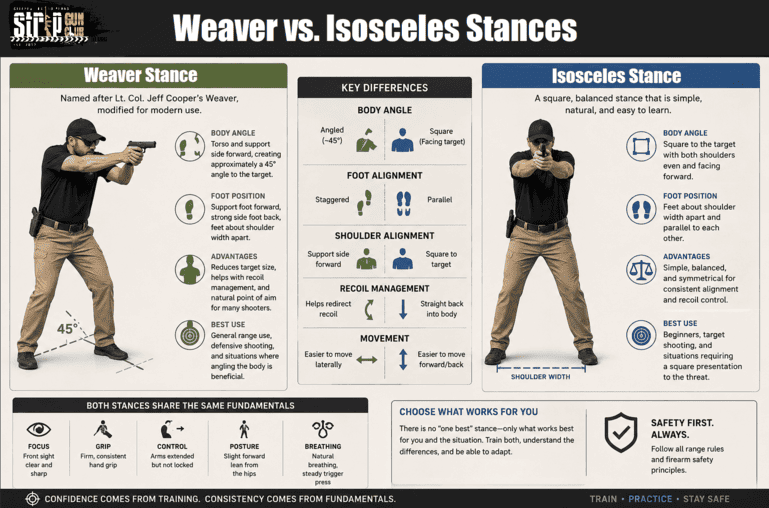
Spend an afternoon at any busy range and you’ll notice two distinct silhouettes: some people bladed at an angle, working visible tension into the firearm, and others squared up behind the sights, mirrored left to right. The Weaver and Isosceles stances are two fundamental methods for holding and shooting a handgun. The debate between them has run for more than half a century. Both work. Both carry trade-offs. The right answer depends on your body, your goals, and what you put into training. This guide breaks down where each technique came from, how to build each one from the feet up, and which deserves the bulk of your practice time.
Why the Way You Stand Matters
Marksmanship is built from the ground up. Your feet form the base, your knees act as shock absorbers, and your torso shifts forward to control the firearm as it cycles. Proper shooting stances enhance recoil management and accuracy. Just as important, a consistent platform gives you something to default to when adrenaline floods in. Under pressure, nobody rises to the occasion; everyone falls back on their training. That’s why good instructors drill foot placement and weight distribution before they ever talk about speed: repeatable structure is what turns one lucky hit into a tight group.
What Is the Weaver Stance?
The Weaver stance was developed by Jack Weaver in the 1950s. Weaver, a Los Angeles County sheriff’s deputy, began dominating Southern California quick-draw matches by doing something radical for the era: bringing a two-handed hold up to eye level while his rivals fired from the hip. Colonel Jeff Cooper championed the technique in print and at his academy, and it soon anchored police and military training across the country.
To build it, stand at roughly a 45-degree angle to the target with your support-side foot forward and your strong-side leg back. Think “support foot forward, gun foot back”, with your knees slightly bent. The firing arm extends almost straight while the support elbow stays sharply bent, pointing at the ground. Then comes the signature element: the firing hand pushes the pistol forward while the support hand applies pulling pressure straight back. The Weaver stance is bladed and asymmetrical using a push-pull tension. That opposing pressure clamps everything together and tames muzzle flip.
Done right, it feels locked in. It provides a stable platform for managing recoil effectively. The bladed position also presents a slimmer profile and pairs beautifully with barricades. The stance allows for quick target acquisition when shooting from cover. That advantage kept it in law enforcement doctrine for decades. Many people also find it relaxing for slow fire, when there is time to set the tension deliberately.
The weaknesses appear once things get dynamic. Situational awareness is reduced on the non-dominant side in the Weaver stance. The stance can restrict mobility and make movement awkward. The problem worsens when a threat appears on your support side. Cross-eye-dominant people often fight to get a clean sight picture from the bladed setup. And a Department of Justice–archived study of nearly 100 real officer-involved encounters points to a deeper issue: Weaver stance shooters often revert to Isosceles during actual shootings. The human body instinctively squares up to danger.
What Is the Isosceles Stance?
If the Weaver is a learned posture, the Isosceles is what your body already wants to do. Stand facing the threat squarely, hips and shoulders level. The Isosceles stance features feet shoulder-width apart. Extend both arms fully; viewed from above, the triangle they form with your chest gives the position its name. Keep your knees slightly bent and roll your weight onto the balls of your feet so your upper body sits just ahead of your hips, driving into the pistol.
The appeal is simplicity. The Isosceles stance is more natural and symmetrical than the Weaver stance. There is no asymmetric tension to manage; both hands press forward together instead of pushing and pulling against each other. Because your eyes, sights, and torso all reference the same centerline, the technique tracks effortlessly between targets. The Isosceles stance is ideal for rapid target acquisition. Police trainers note a practical bonus as well. The Isosceles stance maximizes body armor surface area. Protective panels stay square to the threat rather than exposing the side seams.
No technique is flawless, though. With both feet planted on the same line, the classic version gives up some front-to-back balance, and a hard shove can rock you onto your heels. The stance can feel less stable under rapid-fire conditions. Those gaps are exactly what the modern hybrids were created to close.
Modern Hybrids: Where the Two Techniques Meet
Very few training programs teach either method in pure form anymore. The Tactical stance combines elements of both Weaver and Isosceles. It pairs a squared torso and extended hands with one foot dropped back about half a step, much like a boxer’s base. The modified Weaver stance, often called the Chapman, straightens the firing arm completely so you can index your cheek against it for repeatable sight alignment. The modified Isosceles goes the other way: it keeps the torso squared and the grip symmetrical, but staggers the feet roughly shoulder width apart, drops one foot slightly to the rear, softens both elbows, and adds an aggressive forward lean. Watch any competitive shooter at a major match and this is the silhouette you will see, because it soaks up fast strings of fire while leaving the legs free to move.
Grip and Sights Still Decide the Hits
No amount of clever footwork can rescue a sloppy grip. Build the grip as high on the backstrap as the frame allows, wrap your other hand so both palms apply firm and equal pressure, and keep that grip identical from the first round to the last. From there, precision comes down to the timeless fundamentals: hard front-sight focus, a clean sight picture, and pulling the trigger straight to the rear without disturbing the sights. If your groups wander no matter where your feet are, the fix probably lives in your hands. Our guide on how you should hold a handgun walks through it step by step.
Which Should You Trust for Self Defense?
When your life is on the line, two things dominate: what your body does under stress and where the fight actually happens. Sudden threats make humans crouch, square up, and punch both hands toward the danger. The same reflex behind the reversion findings above. Smart defensive training works with that wiring rather than against it, so the repetitions you bank become muscle memory you can trust at the worst possible moment.
Real encounters also rarely unfold on a flat, well-lit range. They happen in confined spaces: hallways, stairwells, the front seat of a car – where you may be moving, shielding a loved one, or shooting with one hand while the other opens a door. For most people, the Isosceles handles that chaos better. It allows for quicker target acquisition and faster follow-up shots. It is particularly useful in self-defense situations. The Weaver’s bladed geometry still earns its keep in tight angles around cover, where exposing less of yourself matters. A sensible plan: make the squared position your default, then train to defend yourself from compromised spots. Kneeling, one hand only, or on the move. Because a real fight will not wait for you to set your feet.
Which Is Better for Pistol Shooting?
For raw performance, the scoreboard has spoken: squared, staggered platforms dominate practical competition, and most modern training curricula start students there because the technique is faster to learn and holds together under stress. The push-pull approach still fits people who came up shooting that way decades ago, who genuinely perform better with tension, or who spend most of their range time working around cover. There is no prize for ideology. Give your training time to whichever lets you put quick, precise rounds exactly where they need to go, and revisit the choice as your skills mature. Movement drills and shooting on the move will reveal your true preference faster than any article.
Put Both to the Test in Las Vegas
Reading about foot placement only takes you so far; the differences become obvious within a magazine or two of live fire. If you are local or visiting, book a lane at our shooting range in Las Vegas and run the two techniques side by side. Instructors can watch your feet, your grip, and your follow-through, then help you settle into a default position and put it into practice. You will know within an hour which way you would rather stand. First visit? Start with our shooting range tips so your training session goes toward building skill instead of figuring out logistics, and bring your own firearm or try one of the rentals on site.
Frequently Asked Questions
Who created the Weaver technique?
The Weaver stance was developed in the 1950s by Jack Weaver. A Los Angeles County deputy, he proved it in California’s famous “Leatherslap” matches and, with Jeff Cooper’s help, reshaped two-handed marksmanship worldwide.
Can I switch techniques after years of shooting one way?
Yes, and many people do. Expect a few clumsy sessions while the new pattern takes hold. Start with dry-fire training at home, confirm everything at a relaxed pace on the range, and the change usually sticks within a handful of trips.