

357 vs 9mm: Ballistics, Recoil, and Which One Fits You
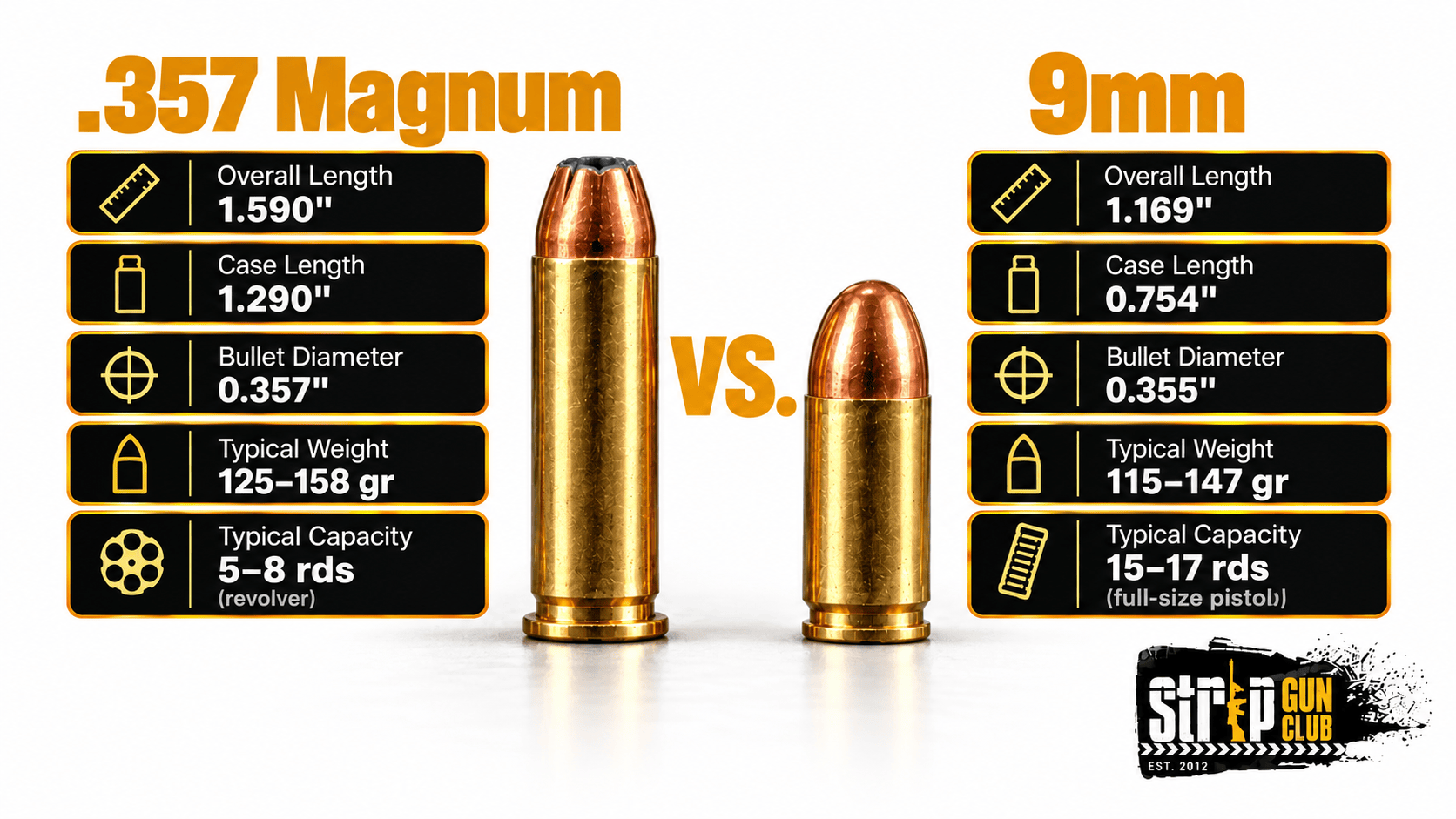
The .357 Magnum and the 9mm Luger fire bullets that are almost exactly the same width. Put them side by side, though, and they behave like two completely different animals. One is the classic magnum revolver round that built its name on raw power. The other is the most popular pistol cartridge in the world, carried by militaries and police forces on every continent.
If you are trying to decide between them, or you just want to know what each one feels like before you shoot it, this guide covers the specs, ballistics, recoil, capacity, cost, and the real-world uses where each cartridge wins.
357 vs 9mm: The Quick Answer
- Power: The .357 Magnum wins. It pushes a bullet of the same weight roughly 25 to 30 percent faster and carries much more energy.
- Recoil: The 9mm wins. In guns of similar weight, the .357 Magnum produces roughly twice the recoil.
- Capacity: The 9mm wins. A full-size 9mm pistol holds 15 to 17 rounds, while most .357 revolvers hold 6 or 7.
- Cost: The 9mm wins. Range ammo is cheaper and easier to find than .357 Magnum.
- Hunting: The .357 Magnum wins, especially out of a lever-action rifle.
- Versatility: The .357 Magnum has the edge, because a .357 revolver can also fire milder .38 Special ammo.
What Is the Difference Between .357 Magnum and 9mm?
The biggest difference is the gun each cartridge is built for. The .357 Magnum is a rimmed revolver cartridge with a long case that holds a lot of powder. The 9mm Luger is a short, rimless cartridge designed to feed from a magazine and cycle through a semi-automatic pistol.
That design split drives everything else. The longer .357 case produces more velocity, more energy, and more recoil. The compact 9mm case lets a pistol stack 15 or more rounds in the grip, recoil less, and cost less to shoot.
One naming note before going further: “357” can also mean the .357 SIG, a bottlenecked semi-auto pistol cartridge that is a different round entirely. Everything in this article refers to the .357 Magnum.
357 vs 9mm Specs Compared
| Specification | .357 Magnum | 9mm Luger |
|---|---|---|
| Introduced | 1935 | 1901 |
| Bullet diameter | .357 in | .355 in |
| Case type | Rimmed | Rimless |
| Case length | 1.290 in | 0.754 in |
| Overall length | 1.590 in | 1.169 in |
| Common bullet weights | 110 to 180 gr | 115 to 147 gr |
| SAAMI max pressure | 35,000 psi | 35,000 psi |
| Typical platform | Revolver | Semi-auto pistol |
Both cartridges run at the same maximum pressure, so the .357’s extra performance comes almost entirely from its longer case, which holds far more powder. It also handles heavier bullets, up to 180 grains in common factory loads. If grain weights are new to you, our guide on what grain means in ammo explains how bullet weight affects velocity and recoil.
A Short History of Both Cartridges
The .357 Magnum
The .357 Magnum came out of 1930s experiments by Elmer Keith and Phillip Sharpe, who were loading the .38 Special far hotter than its original specs. Smith & Wesson introduced the finished cartridge in 1935. The case was lengthened by about a tenth of an inch so the new, much more powerful round could not be loaded into older .38 Special revolvers.
It was aimed squarely at law enforcement. Prohibition-era criminals used cars for cover, and the .38 Special struggled to get through car bodies and early body armor. The .357 Magnum could, and it became the defining police revolver round for decades.
The 9mm Luger
Georg Luger designed the 9x19mm in 1901 by necking out his earlier 7.65x21mm Parabellum cartridge. The German Navy adopted it in 1904 and the German Army in 1908, and it went on to serve through both world wars.
The United States held onto the .45 ACP until the Army adopted the Beretta M9 in 1985. From there, reliable high-capacity pistols like the Glock 17 and SIG P226 pushed the 9mm to the top of the market, and the U.S. military’s current sidearm, the SIG P320 (M17 and M18), is also chambered in 9mm. If you are comparing 9mm against other popular pistol rounds, see our breakdown of .45 ACP vs 9mm.
357 vs 9mm Ballistics: Velocity and Energy
This is where the .357 Magnum earns its name. Here are typical factory figures from a 4-inch barrel:
| Load | Muzzle velocity | Muzzle energy |
|---|---|---|
| .357 Magnum 125 gr | about 1,450 fps | about 585 ft-lbs |
| .357 Magnum 158 gr | about 1,235 fps | about 535 ft-lbs |
| 9mm 115 gr | about 1,160 fps | about 345 ft-lbs |
| 9mm 124 gr | about 1,150 fps | about 365 ft-lbs |
| 9mm 124 gr +P | about 1,180 to 1,250 fps | about 385 to 430 ft-lbs |
| 9mm 147 gr | about 990 fps | about 320 ft-lbs |
Compare the two most similar loads, the .357 Magnum 125 grain and the 9mm 124 grain. The bullets weigh almost the same, but the .357 leaves the barrel about 300 feet per second faster and carries roughly 60 percent more energy. Even hot +P 9mm loads do not close that gap.
The extra speed also gives the .357 a flatter trajectory. At typical handgun distances the difference is small, but past 50 yards the .357 drops noticeably less, which matters for hunters and for anyone ringing steel at longer ranges.
Keep in mind that velocity depends heavily on barrel length. A .357 fired from a 2-inch snub-nose revolver loses a big share of its speed, while the same round fired from an 18-inch lever-action rifle gains a lot.
357 vs 9mm Recoil
More powder and more speed mean more push back into your hands. Fired from guns of similar weight, the .357 Magnum produces roughly twice the recoil energy of the 9mm. It also brings a much louder blast and a bigger muzzle flash, which many first-time shooters notice before they notice the recoil itself.
Gun weight changes the picture a lot. A heavy, all-steel .357 revolver weighing 40 ounces or more soaks up much of the kick and feels more like a strong, rolling push than a slap. A lightweight .357 snub-nose is the opposite, and even experienced shooters find full-power loads unpleasant in one. On the 9mm side, a full-size polymer pistol is about as soft as centerfire handguns get, which is why so many ranges hand a 9mm to first-timers.
For a closer look at what to expect when you pull the trigger, read our guide to understanding recoil.
Stopping Power and Penetration
“Stopping power” gets thrown around a lot in caliber debates, but it is not a measurable number. What can be measured is penetration and expansion. The FBI’s test protocol calls for a bullet to penetrate between 12 and 18 inches of ballistic gelatin, and quality hollow points in both .357 Magnum and 9mm meet that standard.
The .357 Magnum generally penetrates deeper thanks to its extra velocity, and full-power loads tend to create larger wound channels. Modern 9mm hollow points have closed much of that gap, though, which is a big reason law enforcement agencies moved to 9mm pistols. In practice, shot placement matters far more than the small terminal difference between the two. If you want to understand how bullet design affects all of this, our guide to types of bullets covers FMJ, hollow point, and soft point rounds.
Capacity: Cylinder vs Magazine
This category is not close. A revolver’s capacity is limited by how many chambers fit in its cylinder.
- Full-size .357 revolver: 6 rounds in most models, 7 in some, such as the Smith & Wesson 686 Plus
- Compact .357 revolver: usually 5 rounds
- Full-size 9mm pistol: 17 rounds in a Glock 17, 15 in a Beretta M9
- Compact 9mm pistol: 10 to 15 rounds, depending on the model
Reloading is also faster on a semi-auto. You drop the empty magazine and insert a fresh one, while a revolver needs a speed loader or each round loaded by hand. Our guide to the types of pistols goes deeper into how revolvers and semi-autos differ mechanically.
Cost and Availability
The 9mm is the most widely produced handgun cartridge in the world, and its price reflects that. Range-grade 9mm FMJ is usually much cheaper per round than .357 Magnum, often half the price or less. There are also far more 9mm loads on store shelves, and far more 9mm pistols to choose from, many of them with affordable polymer frames.
.357 Magnum ammo costs more because it uses more brass, more powder, and is made in smaller volumes. Quality revolvers also tend to cost more than comparable polymer pistols, since they are built from steel and require more machining. Many revolver owners cut costs by practicing with .38 Special, though that round is still usually pricier than 9mm.
Revolver vs Semi-Auto: How They Shoot Differently
Because each cartridge lives in a different type of gun, choosing between them is really a choice between two shooting experiences.
- Loading: A revolver has no magazine and no slide. You swing out the cylinder, drop in the rounds, and close it. A semi-auto needs a loaded magazine and a racked slide.
- Trigger: Most .357 revolvers are double action, so each trigger press both cocks and fires the gun. That pull is longer and heavier than a typical striker-fired 9mm trigger, which takes practice to master.
- Malfunctions: Revolvers do not depend on recoil to cycle the next round, so a weak grip will not cause a jam. Semi-autos can stall if the shooter “limp-wrists” the gun.
- Brass: A revolver keeps its empty cases in the cylinder. A semi-auto ejects them, so expect hot brass flying to your right.
Whichever platform you pick, grip is the foundation of accuracy. Our guide on how to hold a handgun for maximum accuracy walks through it step by step.
Versatility: .38 Special, Carbines, and Convertible Revolvers
The .357 Magnum’s quiet superpower is that any .357 revolver can also fire .38 Special. The .38 uses the same bullet diameter in a slightly shorter case, and from a heavy revolver it recoils even less than a 9mm. That gives a .357 owner two guns in one: mild .38s for practice and full-power magnums when they want them.
The .357 also pairs well with lever-action rifles like the Henry Big Boy, Marlin 1894, and the many 1873-style rifles, so a shooter can run one cartridge in both a revolver and a rifle. Out of an 18-inch barrel, the .357 gains several hundred feet per second.
The 9mm has its own long guns too, including pistol-caliber carbines and submachine guns like the HK MP5. Some carbines even share magazines with popular 9mm pistols.
A few revolvers bridge the two cartridges. The Ruger Blackhawk Convertible ships with a separate 9mm cylinder, and the Taurus 692 lets you swap between .357 Magnum and 9mm. Never fire 9mm in a standard .357 revolver that is not built or fitted for it, and never try to load .357 Magnum into a 9mm pistol.
Which Is Better for Hunting?
The .357 Magnum is the clear choice. With heavy soft point or hard cast bullets, it can take deer-sized game and feral hogs at close range from a revolver, and out to roughly 100 yards from a lever-action rifle, where state hunting rules allow it. Its flatter trajectory also helps with longer shots.
The 9mm lacks the energy and trajectory for ethical deer hunting in most situations. It works for small game and pests, but few hunters choose it for anything larger.
Which Is Better for Beginners?
For most new shooters, the 9mm is the easier place to start. It recoils less, the ammo is cheap enough to practice often, and modern 9mm pistols have simple controls and light triggers.
There is a solid argument for the .357 Magnum revolver too, as long as it is a full-size, all-steel model loaded with .38 Special. There is no slide to rack and no magazine to load, so it is very simple to operate. The double action trigger is harder to master, but shooters who learn on one usually find every other handgun easier afterward.
The best advice is the one experienced shooters repeat constantly: try both before you decide. Renting a 9mm pistol and a .357 revolver at a range like Strip Gun Club will tell you more in 30 minutes than any spec sheet.
357 vs 9mm Scorecard
| Category | .357 Magnum | 9mm | Winner |
|---|---|---|---|
| Bullet diameter | .357 in | .355 in | Tie |
| Muzzle velocity (124 to 125 gr) | About 1,450 fps | About 1,150 fps | .357 Magnum |
| Muzzle energy (124 to 125 gr) | About 585 ft-lbs | About 365 ft-lbs | .357 Magnum |
| Heaviest common bullet | 180 gr | 147 gr | .357 Magnum |
| Trajectory past 50 yards | Flatter, less drop | More drop | .357 Magnum |
| Penetration | Deeper with full-power loads | Meets FBI 12 to 18 in standard with modern hollow points | .357 Magnum (narrow) |
| Felt recoil | Roughly 2x in guns of similar weight | Soft and controllable | 9mm |
| Muzzle blast and flash | Very loud, large flash | Noticeably milder | 9mm |
| Capacity | 5 to 7 rounds | 10 to 17+ rounds | 9mm |
| Reload speed | Speed loader or one round at a time | Quick magazine swap | 9mm |
| Trigger | Heavy, long double action pull | Light, short striker-fired pull | 9mm |
| Ease of operation | No slide to rack, no magazines to load | Slide, magazine, and safety controls to learn | .357 Magnum |
| Tolerance for a weak grip | Unaffected, nothing to cycle | Can malfunction if limp-wristed | .357 Magnum |
| Ammo cost | Higher per round | Often half the price or less | 9mm |
| Ammo selection | Fewer loads, plus all .38 Special | Widest selection of any handgun cartridge | 9mm |
| Gun selection | Mostly revolvers and lever actions | Pistols, carbines, and submachine guns | 9mm |
| Gun price | Steel revolvers cost more | Many affordable polymer pistols | 9mm |
| Versatility | Also fires milder .38 Special | One power level per load | .357 Magnum |
| Rifle pairing | Lever actions, with a big velocity gain | Pistol-caliber carbines, some share pistol magazines | .357 Magnum |
| Hunting | Deer and hogs at close range | Small game and pests only | .357 Magnum |
| High-volume range practice | Costly, tiring with full-power loads | Cheap and comfortable | 9mm |
| Learning curve | Simple to run, harder to master | Easier to shoot well quickly | 9mm |
| Overall tally | 10 wins | 11 wins | 1 tie |
The .357 Magnum is the better cartridge if you want power, hunting capability, and the flexibility of a revolver that also fires .38 Special. The 9mm is the better choice if you want lower recoil, more rounds, cheaper practice, and the widest selection of guns. In the end, the decision usually comes down to one question: do you want a revolver or a semi-auto pistol?
Shoot Both on the Las Vegas Strip
The fastest way to settle the 357 vs 9mm debate is to fire both, back to back, in the same session. The Pistols Package at Strip Gun Club puts four handguns in your hands, including a Glock of your choice and a .357 Magnum revolver, so you can feel the difference in recoil, trigger, and blast for yourself.
- What you shoot: a 1911, any Glock (including the 9mm Glock 17 or 19), a .357 or .44 Magnum revolver, and a suppressed pistol such as the 9mm SilencerCo Maxim 9
- Experience needed: none, since a dedicated range safety officer stays with you for every shot
- Included: ammunition, targets, eye and ear protection, and unlimited photos and video
- Getting here: free round-trip shuttle from Strip and downtown Las Vegas hotels
- Ages: 10 and up with a parent or legal guardian
Ask your range safety officer to run the 9mm first and finish on the .357. Starting lighter lets you build a feel for the grip and trigger before the magnum’s extra punch.
357 vs 9mm FAQ
Is a .357 Magnum more powerful than a 9mm?
Yes. With bullets of similar weight, the .357 Magnum typically travels about 300 feet per second faster and carries around 60 percent more muzzle energy than a standard 9mm load.
Does a .357 have more recoil than a 9mm?
Yes. In guns of similar weight, the .357 Magnum produces roughly twice the recoil. A heavy steel revolver makes it manageable, while a lightweight snub-nose .357 is sharp and punishing.
Can a .357 revolver shoot 9mm?
Only if it is built or fitted for it. Convertible revolvers like the Ruger Blackhawk Convertible and the Taurus 692 come with a separate 9mm cylinder. Never fire 9mm in a standard .357 revolver.
Can a .357 revolver shoot .38 Special?
Yes. Any .357 Magnum revolver can safely fire .38 Special, which has much milder recoil and is a popular choice for practice.
Is a .357 or 9mm better for a first-time shooter?
Most instructors start beginners on a 9mm because it recoils less and is easier to control. A full-size .357 revolver loaded with .38 Special is also beginner friendly, since it is simple to load and operate.
Is .357 SIG the same as .357 Magnum?
No. The .357 SIG is a bottlenecked cartridge for semi-automatic pistols, built on a .40 S&W case necked down to a 9mm-sized bullet. The .357 Magnum is a rimmed revolver cartridge.
Why is 9mm ammo cheaper than .357 Magnum?
The 9mm uses less brass and powder and is produced in far greater volume than any other handgun cartridge, which keeps its price per round low.
Can I shoot a .357 Magnum and a 9mm in Las Vegas without owning a gun?
Yes. At Strip Gun Club you can shoot both in one session with no license or prior experience. All you need is a government-issued photo ID if you are 18 or older.