

5.7 vs 9mm: Recoil, Ballistics, Cost and Which One to Shoot
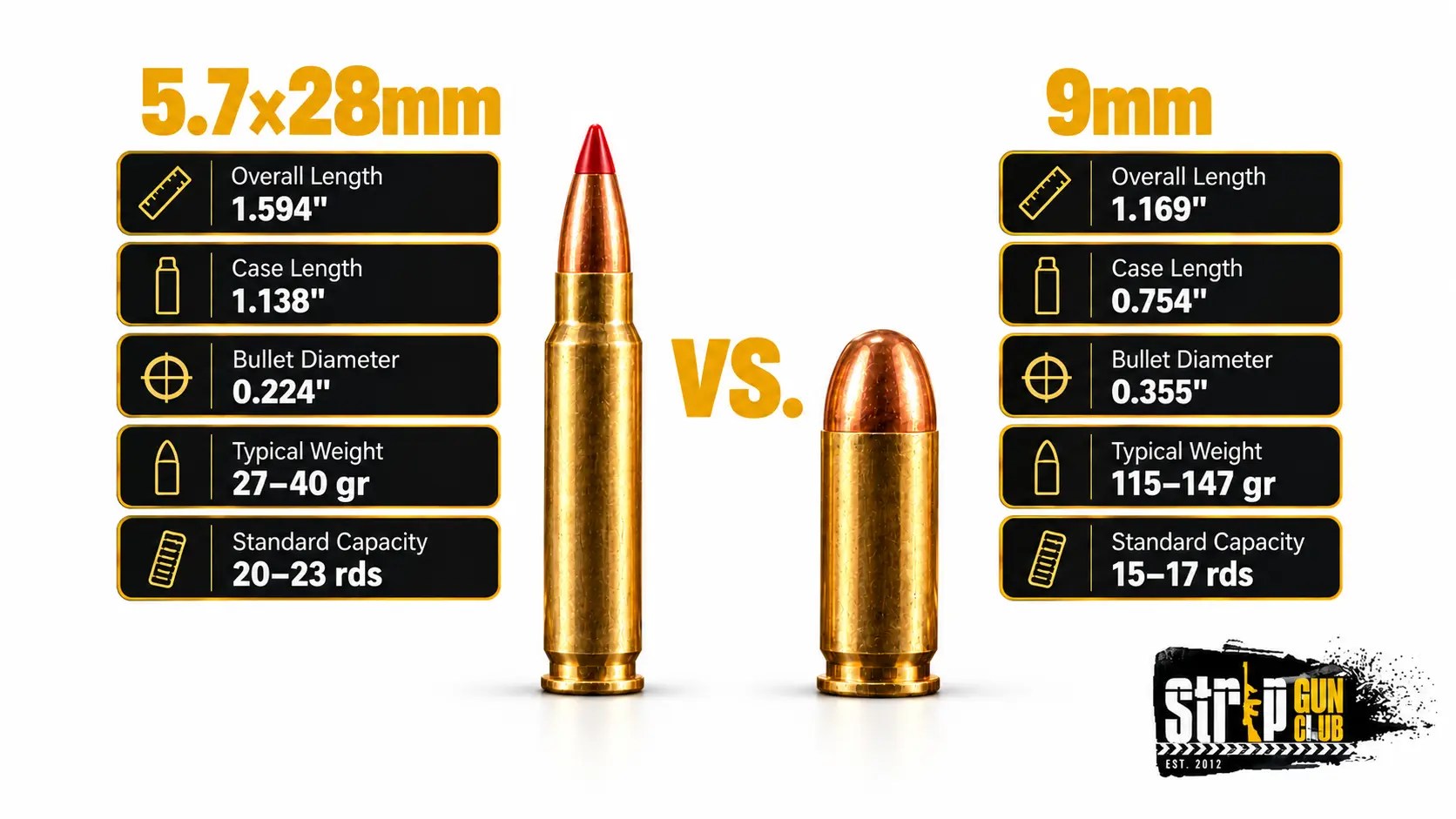
The 5.7x28mm was built to replace the 9mm, and on paper it wins most of the categories that matter at the range: less recoil, a flatter trajectory and more rounds in the magazine. The 9mm wins the categories that matter at the checkout counter and in the gel block: cheaper ammo, far more guns and loads to choose from, and heavier bullets that penetrate deeper.
That split is why the 5.7 vs 9mm debate never really ends. One cartridge looks like a shrunken rifle round and fires a 40 grain bullet at around 1,800 feet per second. The other has been the world’s default handgun cartridge for over a century. Below, we break down how they actually compare, using manufacturer ballistics, independent gel testing and current ammo prices, and what each one feels like when you pull the trigger.
| Category | 5.7x28mm | 9mm | Edge |
|---|---|---|---|
| Bullet diameter | .224 in | .355 in | Depends on goal |
| Typical bullet weight | 27 to 40 gr | 115 to 147 gr | 9mm (mass) |
| Muzzle velocity (pistol) | 1,650 to 1,850 fps | 1,000 to 1,250 fps | 5.7 |
| Muzzle energy (pistol) | 240 to 300 ft-lbs | 330 to 375 ft-lbs | 9mm |
| Free recoil (25 oz pistol) | About 2.1 ft-lbs | About 5.7 ft-lbs | 5.7 |
| Standard pistol capacity | 20 to 23 rounds | 15 to 17 rounds | 5.7 |
| Range ammo cost | Roughly $0.55 to $0.80 per round | Roughly $0.25 to $0.30 per round | 9mm |
| Gun and load options | A few dozen | Thousands | 9mm |
Where Each Cartridge Came From
The two rounds were designed almost 90 years apart, and for different problems.
The 9mm: Georg Luger’s 1902 Workhorse
Georg Luger designed the 9x19mm Parabellum for Deutsche Waffen und Munitionsfabriken (DWM), and it reached the market in 1902 alongside the Luger pistol. It went on to serve in both World Wars, in pistols like the Luger P08 and Browning Hi-Power and in submachine guns like the MP40 and later the HK MP5. NATO standardized it in the 1950s.
Today it is the most popular centerfire handgun cartridge in the world. You will see it called 9mm Luger, 9mm Parabellum, 9x19mm and 9mm NATO, but they are the same round.
The 5.7x28mm: FN Herstal’s Answer to Body Armor
By the late 1980s, soft Kevlar vests were getting good at stopping 9mm ball ammunition. NATO asked for a new weapon cartridge that could defeat armor at distance while staying light and easy to control.
FN Herstal answered with the 5.7x28mm and the FN P90, introduced in 1990. The FN Five-seveN pistol followed in 1998, so both a pistol and a compact carbine could share one round. The P90 itself grew out of the same thinking that shaped the evolution of submachine guns through the 20th century. NATO never formally adopted the 5.7 as a 9mm replacement, but the P90 and Five-seveN went on to serve with military and police units in more than 40 countries.
The armor piercing SS190 load is restricted to military and law enforcement. Civilian 5.7 ammo uses sporting and hunting bullets instead, which matters a lot later in this comparison.
Cartridge Specs Side by Side
The 5.7 is longer and skinnier, with a bottleneck case like a rifle round. The 9mm is a short, straight-walled pistol cartridge with a much “fatter” bullet.
| Spec | 5.7x28mm | 9mm Luger |
|---|---|---|
| Designer | FN Herstal | Georg Luger (DWM) |
| Introduced | 1990 | 1902 |
| Case type | Bottleneck | Straight, slightly tapered |
| Bullet diameter | .224 in | .355 in |
| Case length | 1.138 in | .754 in |
| Overall length | 1.594 in | 1.169 in |
| Common bullet weights | 27, 40 gr (subsonic up to about 62 gr) | 115, 124, 147 gr |
| SAAMI max pressure | High 40,000s psi | 35,000 psi |
A few of these numbers explain everything that follows:
- Bullet diameter: The 5.7 uses the same .224 inch bullet diameter as the 5.56 NATO and .223 Remington, which is why it behaves more like a tiny rifle round than a pistol round. We cover that rifle cartridge in our 308 vs 5.56 breakdown.
- Bullet weight: A standard 9mm bullet weighs three to four times as much as a 40 grain 5.7 bullet.
- Chamber pressure: The 5.7 runs at significantly higher pressure than standard 9mm, which is how it pushes a light bullet so fast.
- Case shape: The slim bottleneck case is what lets 5.7 pistols hold 20 or more rounds in a normal sized grip.
Velocity, Energy and Trajectory
The 5.7 is much faster and shoots much flatter. The 9mm starts with more energy and keeps more of it downrange.
Here is how common factory loads compare, using manufacturer data from pistol-length barrels (about 4 inches for 9mm, 4.8 inches for 5.7), zeroed at 50 yards:
| Load | Muzzle velocity | Muzzle energy | Velocity at 100 yd | Energy at 100 yd | Drop at 100 yd |
|---|---|---|---|---|---|
| 5.7×28 40 gr V-Max | 1,810 fps | 291 ft-lbs | 1,388 fps | 171 ft-lbs | -3.3 in |
| 5.7×28 40 gr FMJ | 1,655 fps | 243 ft-lbs | 1,181 fps | 124 ft-lbs | -4.3 in |
| 9mm 115 gr FMJ | 1,145 fps | 335 ft-lbs | 980 fps | 245 ft-lbs | -7.7 in |
| 9mm 124 gr FMJ | 1,110 fps | 339 ft-lbs | 973 fps | 261 ft-lbs | -7.9 in |
Three things stand out:
- Velocity: Standard 5.7 loads leave the muzzle 500 to 700 fps faster than standard 9mm. That said, some boutique lightweight 9mm loads with 50 to 65 grain bullets run over 1,700 fps, so the gap is about load choice as much as cartridge.
- Energy: The 9mm starts with roughly 15 to 40 percent more energy, and the gap widens with distance because the light 5.7 bullet sheds velocity faster.
- Trajectory: At 100 yards, the 5.7 drops less than half as much as the 9mm. Past 50 yards, that makes the 5.7 noticeably easier to hit with, since you hold closer to where you aim.
At typical pistol distances of 7 to 25 yards, the trajectory difference is practically invisible. It only starts to matter on longer shots, which is also where the 5.7’s lower recoil helps.
Recoil: The 5.7’s Biggest Selling Point
The 5.7 kicks noticeably less than the 9mm. Low recoil was one of FN’s original design goals, and it is the first thing most people mention after shooting a Five-seveN.
The physics are simple. Recoil comes from momentum, and momentum is bullet mass times velocity. A 40 grain bullet at 1,800 fps carries far less momentum than a 115 grain bullet at 1,200 fps, even though the 5.7 is moving faster.
In numbers, a 115 grain 9mm load produces about 5.7 ft-lbs of free recoil energy from a 25 ounce pistol, roughly the weight of an empty Glock 17. A 40 grain 5.7 load from a pistol of the same weight produces about 2.1 ft-lbs. Most shooters describe the felt difference as about a third less recoil, since grip, slide mass and muzzle rise all soften the raw gap.
What that means on the range:
- Follow-up shots: The sights settle back on target faster, so strings of fire stay tighter.
- Muzzle flip: The 5.7 barely climbs, which makes it a forgiving gun for new shooters still learning trigger control.
- Flinch: Less recoil means less anticipation, one of the most common causes of missed shots.
To be fair to the 9mm, it is already one of the softest shooting centerfire pistol cartridges. Good grip technique closes much of the gap, and our guide on how to hold a handgun for maximum accuracy covers that. Nobody puts down a 9mm because it is too hard to handle. The 5.7 is simply softer still.
Magazine Capacity
A full size 5.7 pistol holds 3 to 6 more rounds than a full size 9mm in a standard magazine. The narrow case stacks tighter, so more fit in a grip of similar size.
| Pistol | Caliber | Standard capacity |
|---|---|---|
| PSA Rock 5.7 | 5.7x28mm | 23+1 |
| PSA Rock 5.7 Compact | 5.7x28mm | 21+1 |
| FN Five-seveN | 5.7x28mm | 20+1 |
| Ruger-57 | 5.7x28mm | 20+1 |
| Glock 17 | 9mm | 17+1 |
| Beretta M9 | 9mm | 15+1 |
| Glock 19 | 9mm | 15+1 |
The carbine side is even more lopsided. The FN P90 feeds from a 50 round magazine that lies flat across the top of the receiver, and the KelTec P50 pistol uses the same magazine. Nothing in 9mm packs 50 rounds into a package that compact.
The tradeoff is length. A 5.7 cartridge is about 0.4 inches longer than a 9mm, so 5.7 pistols need a long grip front to back. That is why there are no true subcompact 5.7 pistols, while 9mm guns come in every size down to pocket pistols. For a look at the full range of handgun sizes and designs, see our guide to types of pistols.
Penetration and Terminal Performance
This is where the 9mm wins clearly. Heavier bullets carry more momentum, and momentum is what drives a bullet deep into a target.
The common benchmark is the FBI’s 12 to 18 inch penetration window in ballistic gelatin. Modern 9mm hollow points are engineered around it and typically expand to around 0.60 to 0.70 inches while reaching 12 to 18 inches.
Civilian 5.7 loads struggle with it from a pistol. In Lucky Gunner’s widely cited gel testing, most common FN loads stopped at around 9 to 10 inches, and only the 40 grain V-Max fired from a Five-seveN barely cleared 12 inches. Speer’s 40 grain Gold Dot expanded consistently, but only to about 0.31 inches. Their conclusion was that 5.7 from a pistol performs roughly like a non-expanding 9mm or .380 ACP.
The two rounds also work differently once they hit:
- 9mm: Hollow points expand like a mushroom and cut a wide, consistent channel along the whole path.
- 5.7×28: The light, pointed bullet tends to yaw and tumble, sometimes fragmenting. That creates a narrow entry and a wider disturbance further in, but less depth overall.
Bullet design drives a lot of this. Our guide to types of bullets explains how FMJ, hollow point and polymer tipped designs like the V-Max behave differently.
Pistol vs Carbine: Where the 5.7 Comes Alive
The 5.7 was designed for the P90 first and the pistol second, and it shows. Its higher pressure and larger case capacity let it keep gaining speed in a longer barrel, while 9mm burns most of its powder in the first few inches.
- 5.7 from a pistol: About 1,650 to 1,850 fps with common 40 grain loads.
- 5.7 from the P90: The military SS190 load leaves the P90’s 10.4 inch barrel at roughly 2,350 fps, and even civilian loads gain several hundred fps over pistol velocities.
- 9mm from a carbine: A 16 inch barrel adds speed too, usually a little over 100 fps for standard loads, but the 9mm is still a pistol round at heart.
That is why the P90 is the gun most people picture when they think of 5.7. With the stock in your shoulder, a 50 round magazine on top and almost no recoil, it feels unlike any 9mm submachine gun, including the HK MP5.
Suppressed and Subsonic Shooting
Here the roles flip. Heavy 147 grain subsonic 9mm is one of the quietest and most reliable suppressed setups around. Subsonic 5.7 exists, but with bullets topping out around 62 grains, energy drops to about 150 ft-lbs and some guns struggle to cycle it. If quiet shooting is the goal, the 9mm is the better match.
Cost, Availability and Gun Options
The 9mm wins every practical category here, and it is not close.
Ammo Cost
Comparing the same product line keeps it fair. In early 2026, the costs was about $0.26 per round in 9mm and $0.78 per round in 5.7×28, almost exactly triple. Across brands, 5.7 range ammo usually costs two to three times as much as 9mm FMJ, so a single 20 round magazine through a Five-seveN can cost $15 or more.
The gap shrinks with premium hollow points, where 5.7 and 9mm defensive loads are priced much closer together.
Availability and Load Options
The 9mm is the highest volume handgun cartridge in the world, made by hundreds of manufacturers in steel, brass and aluminum cases, from cheap range ball to specialty match and subsonic loads. The 5.7 has a much shorter list, mostly from FN, Federal, Speer, Hornady and a few boutique makers.
Reloading
You can reload 5.7 brass, but it is not recommended. Factory 5.7 cases carry a coating that helps them extract smoothly from delayed blowback guns, and that coating does not survive repeated reloading. The 9mm is one of the easiest and cheapest cartridges to reload.
Gun Options
- 9mm: Practically every pistol maker builds 9mm guns, from Glock, Sig Sauer, Smith & Wesson and Beretta to budget brands, in sizes from pocket pistols to full size competition guns and carbines.
- 5.7×28: The main pistols are the FN Five-seveN, Ruger-57, Smith & Wesson M&P 5.7, PSA Rock and KelTec PR57, plus the FN PS90 carbine and the KelTec P50.
5.7 vs 9mm: Which Should You Shoot?
For most shooters, the 9mm is the better all around cartridge, and the 5.7 is the more interesting one. The answer depends on what you want out of it.
Choose the 9mm if you care about:
- Budget: Ammo costs a third to half as much, so every range trip goes further.
- Choice: Thousands of guns and loads, in every size and price range.
- Penetration: Heavier bullets with decades of proven, tested performance.
- Suppressors: Heavy subsonic loads that run quietly and reliably.
Choose the 5.7 if you care about:
- Soft shooting: Less recoil and muzzle flip than almost any centerfire pistol round.
- Capacity: 20 or more rounds in a standard pistol magazine, and 50 in a P90.
- Distance: A flatter trajectory that makes hits past 50 yards easier.
- Something different: The engineering is genuinely unusual, and the guns are a blast to shoot.
The arguments for the 5.7 sound familiar for a reason. Higher capacity, softer recoil and easier follow-up shots are exactly what 9mm fans used to win the old .45 ACP vs 9mm debate. Whether the 5.7 eventually does to the 9mm what the 9mm did to the .45 depends mostly on ammo prices coming down.
The honest way to settle it is to shoot both. Spec sheets cannot tell you how a gun feels in your hands, and that is where the 5.7 usually wins people over. At Strip Gun Club, you can do exactly that on the Las Vegas Strip, with no license or experience needed.
Shoot 5.7 and 9mm Back to Back in Las Vegas
The fastest way to feel the difference is to fire both rounds through full auto guns in the same session. The Submachine Guns Package puts 50 rounds through the 9mm HK MP5 and 50 rounds through the 5.7x28mm FN P90, plus 50 rounds through the HK UMP in .40 or .45. That is 150 rounds of full auto for $299.95 per person.
Every session includes:
- Range safety officer: A dedicated RSO who loads, demonstrates and stands with you for every round.
- Gear: Ammunition, targets, and eye and ear protection.
- Media: Unlimited photos and video of your session.
- Transport: Free round-trip shuttle from Strip and downtown Las Vegas hotels.
Want the pistol comparison too? The FN Five-seveN and a full lineup of 9mm pistols, including the Glock 17, Glock 19, Sig P226 and Beretta M9, are in our arsenal, and the Build Your Own Package lets you pair a pistol with up to six long guns. No license or prior experience is needed, and shooters 10 and up can take part with a parent or legal guardian. Find us at 2235 South Las Vegas Boulevard, right on the Strip.
5.7 vs 9mm FAQ
Is 5.7 better than 9mm?
It depends on the category. The 5.7 has less recoil, a flatter trajectory and higher magazine capacity. The 9mm has cheaper ammo, far more gun and load options, and deeper penetration from heavier bullets. For most shooters the 9mm is the more practical choice.
Is 5.7 more powerful than 9mm?
No. The 5.7 is faster, but standard 9mm loads carry more muzzle energy, roughly 330 to 375 ft-lbs versus about 240 to 300 ft-lbs for common 5.7 loads from a pistol. The 9mm also holds its energy better downrange.
Does 5.7 have less recoil than 9mm?
Yes. A 40 grain 5.7 load produces roughly a third of the free recoil energy of a 115 grain 9mm load from a pistol of the same weight. Most shooters describe the felt difference as about one third softer.
Was the 5.7×28 designed to replace the 9mm?
Yes. FN Herstal developed it in the late 1980s in response to a NATO request for a cartridge that could defeat body armor. NATO never formally replaced the 9mm, but the 5.7 was adopted by military and police units in more than 40 countries.
Why is 5.7 ammo so expensive?
It is made in far smaller volumes than 9mm, by fewer manufacturers, and the cases need a special coating. Range ammo usually runs two to three times the price of 9mm FMJ.
Is 5.7×28 the same as 5.56?
No. Both use a .224 inch diameter bullet, but the 5.56 NATO is a much larger rifle cartridge with several times the powder and velocity. The two are not interchangeable.
Can I shoot a 5.7 and a 9mm in Las Vegas without a license?
Yes. At Strip Gun Club, no license, permit or experience is required. A range safety officer guides you through every gun, and shooters 10 and older can participate with a parent or legal guardian.